---
title: How to Choose Between an SEO Agency, Consultant or Fractional
description: Compare SEO agency, consultant, and fractional models for B2B SaaS. Pricing, capabilities, and a decision framework to find the right fit for your goals.
image: https://www.seo-growup.com/hubfs/How%20to%20Choose%20Between%20an%20SEO%20Agency%2c%20Consultant%20or%20Fractional.webp
---
[Skip to main content](https://www.seo-growup.com/blog/seo-agency-vs-consultant-vs-fractional-lead#main)
[ ](https://www.seo-growup.com)
- [Show submenu for Services Services](https://www.seo-growup.com/b2b-saas-seo-services)
- [LLM SEO](https://www.seo-growup.com/llm-seo-agency-for-b2b-saas-companies)
- [Show submenu for SEO Audit SEO Audit](https://www.seo-growup.com/seo-audit-for-b2b-saas-companies)
- [LLM Visibility Audit](https://www.seo-growup.com/ai-search-audit-services)
- [Content Audit](https://www.seo-growup.com/b2b-saas-content-audit-services)
- [Copywriting Audit](https://www.seo-growup.com/website-copywriting-audit-service)
- [SEO Consultancy](https://www.seo-growup.com/seo-consultancy-for-b2b-saas-companies)
- [Fractional SEO](https://www.seo-growup.com/fractional-seo-consultancy-for-b2b-saas-companies)
- [Content Marketing](https://www.seo-growup.com/b2b-saas-content-marketing-agency)
- [Web Copywriting](https://www.seo-growup.com/b2b-saas-copywriting-agency)
- [SEO Link Building](https://www.seo-growup.com/b2b-saas-link-building-agency)
- [Pricing](https://www.seo-growup.com/pricing)
- Show submenu for Clients Clients
- Show submenu for By Stage By Stage
- [SEO for Startups](https://www.seo-growup.com/b2b-saas-startup-seo-agency)
- [SEO for Scale-Ups](https://www.seo-growup.com/seo-agency-for-b2b-saas-scaleups)
- [SEO for Enterprises](https://www.seo-growup.com/enterprise-b2b-saas-seo-agency)
- Show submenu for By Sector By Sector
- [ConTech](https://www.seo-growup.com/construction-tech-seo-agency)
- [EdTech](https://www.seo-growup.com/seo-agency-for-ed-tech)
- [FinTech](https://www.seo-growup.com/fintech-seo-agency)
- [HR Tech](https://www.seo-growup.com/seo-agency-for-hr-tech)
- Show submenu for Company Company
- [Why GrowUp](https://www.seo-growup.com/why-growup)
- [Success Stories](https://www.seo-growup.com/success-stories)
- Show submenu for Resources Resources
- Show submenu for Hub Hub
- [Vetting SEO Partners](https://www.seo-growup.com/choosing-a-b2b-saas-seo-partner)
- [Audit Engagements](https://www.seo-growup.com/b2b-saas-seo-audit-guide)
- [Blog](https://www.seo-growup.com/growup-blog)
- [eBooks & Templates](https://www.seo-growup.com/ebooks-and-templates)
- [GTM Prompt Library](https://www.seo-growup.com/gtm-prompt-library)
- [Past Newsletters](https://www.seo-growup.com/newsletter)
- [Glossary](https://www.seo-growup.com/glossary)
Open main navigation
Close main navigation
- Show submenu for Services Services
- Services
- [Services](https://www.seo-growup.com/b2b-saas-seo-services)
- [LLM SEO](https://www.seo-growup.com/llm-seo-agency-for-b2b-saas-companies)
- Show submenu for SEO Audit SEO Audit
- SEO Audit
- [SEO Audit](https://www.seo-growup.com/seo-audit-for-b2b-saas-companies)
- [LLM Visibility Audit](https://www.seo-growup.com/ai-search-audit-services)
- [Content Audit](https://www.seo-growup.com/b2b-saas-content-audit-services)
- [Copywriting Audit](https://www.seo-growup.com/website-copywriting-audit-service)
- [SEO Consultancy](https://www.seo-growup.com/seo-consultancy-for-b2b-saas-companies)
- [Fractional SEO](https://www.seo-growup.com/fractional-seo-consultancy-for-b2b-saas-companies)
- [Content Marketing](https://www.seo-growup.com/b2b-saas-content-marketing-agency)
- [Web Copywriting](https://www.seo-growup.com/b2b-saas-copywriting-agency)
- [SEO Link Building](https://www.seo-growup.com/b2b-saas-link-building-agency)
- [Pricing](https://www.seo-growup.com/pricing)
- Show submenu for Clients Clients
- Clients
- Show submenu for By Stage By Stage
- By Stage
- [SEO for Startups](https://www.seo-growup.com/b2b-saas-startup-seo-agency)
- [SEO for Scale-Ups](https://www.seo-growup.com/seo-agency-for-b2b-saas-scaleups)
- [SEO for Enterprises](https://www.seo-growup.com/enterprise-b2b-saas-seo-agency)
- Show submenu for By Sector By Sector
- By Sector
- [ConTech](https://www.seo-growup.com/construction-tech-seo-agency)
- [EdTech](https://www.seo-growup.com/seo-agency-for-ed-tech)
- [FinTech](https://www.seo-growup.com/fintech-seo-agency)
- [HR Tech](https://www.seo-growup.com/seo-agency-for-hr-tech)
- Show submenu for Company Company
- Company
- [Why GrowUp](https://www.seo-growup.com/why-growup)
- [Success Stories](https://www.seo-growup.com/success-stories)
- Show submenu for Resources Resources
- Resources
- Show submenu for Hub Hub
- Hub
- [Vetting SEO Partners](https://www.seo-growup.com/choosing-a-b2b-saas-seo-partner)
- [Audit Engagements](https://www.seo-growup.com/b2b-saas-seo-audit-guide)
- [Blog](https://www.seo-growup.com/growup-blog)
- [eBooks & Templates](https://www.seo-growup.com/ebooks-and-templates)
- [GTM Prompt Library](https://www.seo-growup.com/gtm-prompt-library)
- [Past Newsletters](https://www.seo-growup.com/newsletter)
- [Glossary](https://www.seo-growup.com/glossary)
- [Get In Touch](https://www.seo-growup.com/get-in-touch)
[Get In Touch](https://www.seo-growup.com/get-in-touch)
# How to Choose Between an SEO Agency, Consultant or Fractional
by [Muiz Thomas](https://www.seo-growup.com/blog/author/muiz-thomas)
Feb 19, 2026
TL;DR:
If you’re Series A, pre-$5M ARR, and organic is an afterthought: Hire an agency. You don’t have the internal bandwidth to manage a consultant or give a fractional lead enough context to move fast. Invest $6K–$10K/mo, get a team executing in 30 days, see pipeline traction in 4–6 months.
If you’re Series B, $10M–$30M ARR, and organic is starting to contribute but inconsistently: Go fractional. A Fractional SEO Lead at $8K–$15K/mo gives you senior strategic ownership without the $160K+ salary. They set the roadmap, manage an agency or freelancers for execution, and report directly to you. Total cost: $96K–$180K annually. You get accountability without headcount.
If you’re Series C+, $50M+ ARR, and organic drives 30–40%+ of pipeline: Go full-stack. Senior SEO consultant for a 90-day deep-dive strategy ($15K–$30K), then hire a Director of Organic Growth to own execution internally. Use the consultant for quarterly audits and accountability. You’ve earned the right to build in-house. Protect the asset.
## Agency, Consultant, or Fractional: Which SEO Model Works for B2B SaaS
Almost every growth-stage SaaS company runs into this decision at some point.
You’ve got an organic channel that’s half-working. Traffic is growing [but not converting](https://docs.google.com/spreadsheets/d/1uTSXUXbP49n5pwV1cF4XWklcaddh96d2ms_mRq-Mlz8/edit?usp=sharing). You’ve got a handful of articles ranking on page two. Someone in leadership says “we need to get serious about SEO.”
So you hire someone, an agency, a consultant, whoever has a good deck and a plausible case study, and 90 days later you’re still not sure if it’s working.
More often than not, what’s actually going on is a mismatch between the model you’re running and the results you’re expecting.
| **Model** | **What You Get** | **Best For** | **Biggest Risk** |
| --- | --- | --- | --- |
| **SEO Agency** | Full team: technical SEO, content, link building, account management | SaaS companies that need execution at scale but don’t have in‑house SEO capacity | High traffic, low pipeline because the agency doesn’t fully understand your product, ICP, or sales cycle |
| **SEO Consultant** | Senior diagnosis: audits, strategy, technical deep-dives, roadmap | Teams with a specific question to answer or a clear diagnostic need | You get a great deck and roadmap, but no one internally has time or ownership to implement it |
| **Fractional SEO Lead** | Senior strategic ownership 2–3 days/week; owns the roadmap and orchestrates internal and/or agency execution | Growth‑stage companies that need senior ownership of the channel without a full‑time director | Context switching limits depth; without strong internal support, the roadmap never fully embeds |
The right model also depends on what you can realistically spend, here’s how the numbers break down.
## What Each SEO Model Costs in 2026 (Agency, Consultant, Fractional)
Here’s how pricing breaks down across all three models for 2026.
### B2B SaaS SEO Agency Pricing: What a Monthly Retainer Gets You
A [**specialised B2B SaaS SEO agency**](https://www.seo-growup.com/) typically structures pricing around deliverables and outcomes, with fixed monthly retainers that look like this:
| **Engagement Model** | **Monthly Retainer** | **What You Get** | **Best For** |
| --- | --- | --- | --- |
| [**Startups**](https://www.seo-growup.com/b2b-saas-startup-seo-agency) | $4,000–$6,000 | Technical audit + on-page optimisation, 4–6 articles/month, basic link building | Series A companies validating SEO as a growth channel |
| [**Growth/Scaleups**](https://www.seo-growup.com/seo-agency-for-b2b-saas-scaleups) | $6,000–$10,000 | Comprehensive technical SEO, 8–12 articles/month, active link acquisition, conversion optimisation | Series B scaling organic to 20–30% of new pipeline |
| [**Enterprises**](https://www.seo-growup.com/enterprise-b2b-saas-seo-agency) | $10,000–$20,000+ | Full-stack SEO + content + CRO + attribution modeling, dedicated strategist | Series C+ or competitive verticals (fintech, HR tech) |
**Annual cost for a Growth engagement:** $72,000–$120,000.
### SEO Consultant Pricing: Project Fees and Retainer Rates
| **Engagement Type** | **Typical Cost** | **Deliverable** | **Best For** |
| --- | --- | --- | --- |
| **SEO Audit** | $5,000–$15,000 | [Full website audit](https://www.seo-growup.com/b2b-saas-seo-audit-guide) with prioritised initiatives | Understanding why rankings have stalled or dropped |
| **Strategy Sprint (90 days)** | $15,000–$30,000 | Keyword strategy, content architecture, execution roadmap | Building an SEO program from a standing start |
| **Ongoing Advisory** | $3,000–$8,000/mo | Monthly strategy sessions, QBRs, roadmap oversight | Keeping an in-house team focused and on track |
| **Interim SEO Director** | $10,000–$20,000/mo | Full strategic ownership while you recruit | Covering a gap after a senior departure |
**Annual cost for ongoing advisory:** $36,000–$96,000.
### Fractional SEO Lead Pricing: What to Expect at Each Engagement Level
| **Engagement Level** | **Monthly Cost** | **What You Get** | **Best For** |
| --- | --- | --- | --- |
| **Light-touch** | $4,000–$7,000 | Strategy + oversight of execution | Channel is running, needs strategic governance |
| **Core** | $8,000–$15,000 | Own the roadmap, manage agency/freelancers, attend leadership meetings | Series B scaling organic without a full-time hire |
| **Near-full-time** | $15,000–$25,000 | Effectively a Head of SEO without the permanent contract | Pre-hire phase for Series C building in-house |
**Annual cost for a Core fractional engagement:** $96,000–$180,000.
### Year 1 Total Cost Comparison: Agency vs Consultant vs Fractional SEO
When you add everything up, the comparison looks like this:
| **Cost Category** | **Agency (Growth tier)** | **Consultant (Strategy + Advisory)** | **Fractional Lead (Core)** |
| --- | --- | --- | --- |
| Monthly Fees | $6,000–$10,000 | $4,000–$8,000 (advisory) | $8,000–$15,000 |
| Setup / Onboarding | Included | $10,000–$20,000 (strategy sprint) | Included |
| Execution Capacity | Included | ❌ You provide it | Managed (agency/freelancers extra) |
| Tool Stack | Included | Separate ($10K–$20K) | Separate ($10K–$20K) |
| **TOTAL** | **$72,000–$120,000** | **$68,000–$116,000** | **$106,000–$200,000** |
On paper, the consultant model feels lean. In practice, it assumes you already have the bandwidth to execute.
If you don’t, you’re adding freelancers or an agency on top, at which point you’re close to the fractional cost anyway, just without the same integrated ownership.
See what your true total cost of ownership looks like, run the full calculation below.
[Calculate Your TCO](https://www.seo-growup.com/blog/seo-agency-vs-consultant-vs-fractional-lead#seo-cost-calculator)
## SEO Agency vs Consultant vs Fractional Lead: Capability Comparison for B2B SaaS
Cost is one dimension, but so is execution. This matrix compares your three options across what actually drives results at a growth-stage company.
| **Capability** | **Agency** | **Consultant** | **Fractional Lead** |
| --- | --- | --- | --- |
| **Speed to Impact** | Fast. Executing within 30 days. | Slow. Strategy delivered; execution falls to you. | Moderate. 30–60 days to orient, then builds momentum. |
| **Strategic Ownership** | Partial. Account managers own the relationship, not the outcomes. | Strong, for the duration of the engagement. | Strong and continuous. They stay in the problem. |
| **Execution Capacity** | High. Dedicated team of specialists. | None. You source and manage implementation. | Managed. They direct execution but rarely do it themselves. |
| **Depth of Expertise** | Broad. Technical, content, links, CRO, across a team. | Deep but narrow. One or two domains done well. | Senior generalist. Ceiling depends on the individual. |
| **Scalability** | High. Retainer adjusts as your program grows. | Limited. One person, fixed hours, defined scope. | Moderate. Scale by expanding scope or adding an agency layer. |
| **Cost Predictability** | High. Fixed monthly retainer, no surprises. | Variable. Project fees shift with scope. | High. Fixed monthly rate, execution costs separate. |
| **Product and ICP Fluency** | Often weak. Generic agencies default to traffic, not pipeline. | Varies. Depends on vertical experience. | Compounds over time. Gets sharper the longer they’re in. |
| **Risk Profile** | Medium. A poor fit costs you 6–12 months of retainer. | Low. Short engagements cap the downside. | Medium. Losing them mid-program disrupts continuity. |
No model wins across every dimension.
The agency gets you moving fastest; the consultant gives you the clearest diagnosis; the fractional lead gives you the most durable ownership. Which one matters most depends on where you are in the program.
## Decision Framework for Picking the Right SEO Agency, Consultant, or Fractional Lead
Answer these questions honestly before commiting to a model.
### 1. What’s Your Current Organic Baseline?
**If organic is under 10% of traffic and you’ve never invested in SEO:** You’re starting from scratch. Agencies have done this dozens of times. Consultants will give you a strategy you won’t be able to implement without them. Go agency.
**If organic is 15–30% of pipeline and growing inconsistently:** You’ve validated the channel but it lacks operational discipline. A fractional lead who owns the roadmap and manages execution is the right fit. They’ll stabilise what’s working and systematise what isn’t.
**If organic drives 35%+ of pipeline:** You’ve built something valuable. Protect it with dedicated ownership. A consultant for a quarterly audit, and a full-time Director or senior hire who owns the channel day-to-day.
Scoring:
- Organic \<10% → **Agency vote**
- Organic 15–30% → **Fractional vote**
- Organic 35%+ → **Consultant + In-house vote**
### 2. Do You Have Internal Execution Capacity?
Be honest. Can your engineering team [prioritise SEO initiatives](https://www.seo-growup.com/seo-audit-for-b2b-saas-companies) within a sprint? Do you have a content team who can execute at the volume you need? Is there someone internal who can be the day-to-day point of contact?
**If no:** Don’t hire a consultant. Their recommendations will sit in a backlog for six months. Also don’t hire a fractional lead expecting them to do the writing, the outreach, and the technical fixes themselves. Hire an agency that handles full implementation.
**If yes:** You have options. A fractional lead who manages your internal team and an agency for specialist tasks (link building, technical audits, digital PR).
Scoring:
- No internal capacity → **Agency vote**
- Some capacity → **Fractional vote**
- Strong internal team → **Consultant vote**
### 3. What’s Your Time Horizon to Pipeline Impact?
If you need organic contributing 15–20% of SQLs within 6 months: Agency. They’re executing in 30 days. Consultants and fractional leads take longer to orient before they compound.
If you’re planning 12–18 months out and can absorb a slower ramp: Fractional is worth it. The compounding value of a fractional lead who becomes deeply embedded in your business over 18 months often outpaces what an agency delivers, especially if your product is complex or your ICP is narrow.
If you have a specific tactical problem (site migration, penalty recovery, technical debt): Consultant. Defined scope, defined outcome, defined end date.
Scoring:
- \<6 months → **Agency vote**
- 6–18 months → **Fractional vote**
- Specific project → **Consultant vote**
### 4. How Specialised Is Your Market?
If you’re horizontal SaaS (project management, CRM, HR tech): Agencies have your framework. They’ve done this dozens of times. You benefit from their scale.
If you’re vertical SaaS (healthtech, fintech, legaltech, logistics): Generic agencies will produce generic content. You need either an agency with provable vertical experience or a fractional lead who’s worked in your category before. Ask to see content samples from your specific vertical before you commit.
If you’re regulated or deeply technical: You probably need a fractional lead who’s worked in your space, supported by specialist writers with domain expertise. Generic content won’t rank, and won’t convert even if it does.
Scoring:
- Horizontal SaaS → **Agency vote**
- Vertical SaaS → **Fractional vote**
- Regulated/technical → **Fractional or** **Consultant vote**
### 5. What’s Your Management Bandwidth?
**If you’re stretched thin and can’t give a vendor meaningful attention:** Agency, with clear deliverables and a dedicated internal POC who isn’t you. Without that structure, retainers drift and nobody notices until month six.
**If you can carve out 3–5 hours per week for deep strategic collaboration:** Fractional lead. The compounding is worth it, but only if you show up as a genuine stakeholder, not just a budget approver.
**If you need answers fast and don’t need ongoing management:** Consultant, for the project, then decide what comes next.
Scoring:
- Low bandwidth → **Agency vote**
- Medium bandwidth → **Fractional vote**
- High bandwidth → **Consultant vote**
### Calculate Your Score
**Tally your votes:**
- Agency votes: \_\_\_ / 5
- Fractional votes: \_\_\_ / 5
- Consultant votes: \_\_\_ / 5
**Decision rules:**
| **Scenario** | **Decision Rule** |
| --- | --- |
| **Plurality winner** | Whichever model has the most votes wins. |
| **Tie: Agency + Fractional** | Go Fractional. You have enough internal capacity and time horizon to make strategic ownership worth it, and a good fractional lead can manage agency execution beneath them if you need to scale. |
| **Tie: Fractional + Consultant** | Go Fractional. You have the internal infrastructure to implement, the question is whether you need ongoing management. |
| **Tie: Agency + Consultant** | Go Agency first. Validate the channel with execution before you invest in strategy. Once you have data, you’ll know which questions are actually worth asking. |
| **Three-way tie** | Default to Fractional. It hedges speed against strategic depth while you build internal clarity on what the channel actually needs. |
**Recommended Reading:** [Vetting B2B SaaS SEO Partners (2026 Guide)](https://www.seo-growup.com/choosing-a-b2b-saas-seo-partner)
## GrowUp vs Building Your Own Multi-Vendor SEO Stack
At [**GrowUp**](https://www.seo-growup.com/), we work exclusively with B2B SaaS companies from Series A through enterprise. The table below maps our unified model against the friction of stitching together your own vendor stack.
| **Deliverable** | **Vendor Mix** | **GrowUp** |
| --- | --- | --- |
| **Vendor Selection** | 4–8 weeks of procurement, RFPs, and reference calls. High chance of selecting on pitch quality rather than SEO capability. | You don’t select us on a deck. We open with a [site-wide audit](https://www.seo-growup.com/b2b-saas-seo-audit-guide) and a custom roadmap. You evaluate us on evidence. |
| **Strategic Roadmap** | **Agency:** frameworks built for the average client. **Fractional:** strong if they’ve worked in your vertical, variable if they haven’t. **Consultant:** sharp diagnosis, no guarantee of implementation. | Revenue-first roadmap built around your SQL and ACV targets. Every priority maps to your GTM reality. |
| **Content Production** | **Agency:** volume without depth. **Fractional:** strategy without a writing team unless they source one. **Consultant:** neither. | [Specialist B2B SaaS writers](https://www.seo-growup.com/b2b-saas-content-marketing-agency) with PLG and enterprise sales motion experience. Ready from day one. |
| **Technical SEO** | Agency recommendations queue up in engineering backlogs. Fractional leads flag the same issues but rarely own the fix. Consultants identify problems they can’t resolve. | We own technical execution. Audits, fixes, and deployments handled directly, prioritised by revenue impact. |
| **Link Acquisition** | Internal teams struggle to build publisher relationships at scale. Outreach is manual and inconsistent. | Full-scale authority engine. Category-relevant placements that strengthen ranking equity and brand trust where it counts. |
| **Pipeline Attribution** | Traffic reports. Rankings reports. Vanity metrics that don’t move a board conversation. | Custom dashboards that tie every organic dollar to MQLs, SQLs, and closed-won revenue. A real-time P&L for your SEO channel. |
| **AI Integration** | Slow adoption. Internal teams and fractional leads spend months on R&D instead of execution. | Integrated AI stack for opportunity clustering, draft generation, and predictive ROI forecasting. Embedded in standard execution. |
| **Accountability** | Distributed across vendors. Agency, fractional, and consultant each own a slice, but nobody owns the outcome. | One partner. One roadmap. One owner. We show up to your QBRs and defend the numbers. |
If this clarified the trade-offs, we’re happy to talk through what the right SEO structure looks like for your stage and growth targets.
[Schedule a Consultation](https://www.seo-growup.com/get-in-touch)
## Case Study: Why This Series A Chose Agency Over Fractional or Consultant
To make this concrete, here’s how one UK-based SaaS company navigated the decision.
### AI Project Management Platform (Series A)
**Context:**
- Organic traffic: decent volume, but only 8% of demo pipeline
- Trial-to-paid conversion: 12% (vs. 18-22% industry benchmark)
- Homepage converting at 1.8%; demo-to-close at 23%
**Why they chose agency (us) over a consultant or fractional lead:**
They needed speed, cross-functional execution, and funnel clarity. A consultant would have diagnosed the problem but left implementation to them. A fractional lead would have taken 60–90 days to orient before they could drive meaningful change. An agency with the right vertical experience could move across technical SEO, messaging, and conversion in parallel, from day one.
**Investment:** $7,500/month = $90K annually.
**What changed:**
- **Phased 1: Funnel diagnosis.** We [audited the entire inbound motion](https://www.seo-growup.com/go-to-market-advisory-for-b2b-saas), not just SEO. Messaging, content overlap, demo flow, and trial activation were all working against each other.
- **Phase 2: Conversion-first rebuild.** Messaging was rebuilt around the specific outcomes that mattered to the economic buyer, not product capabilities, but business impact.
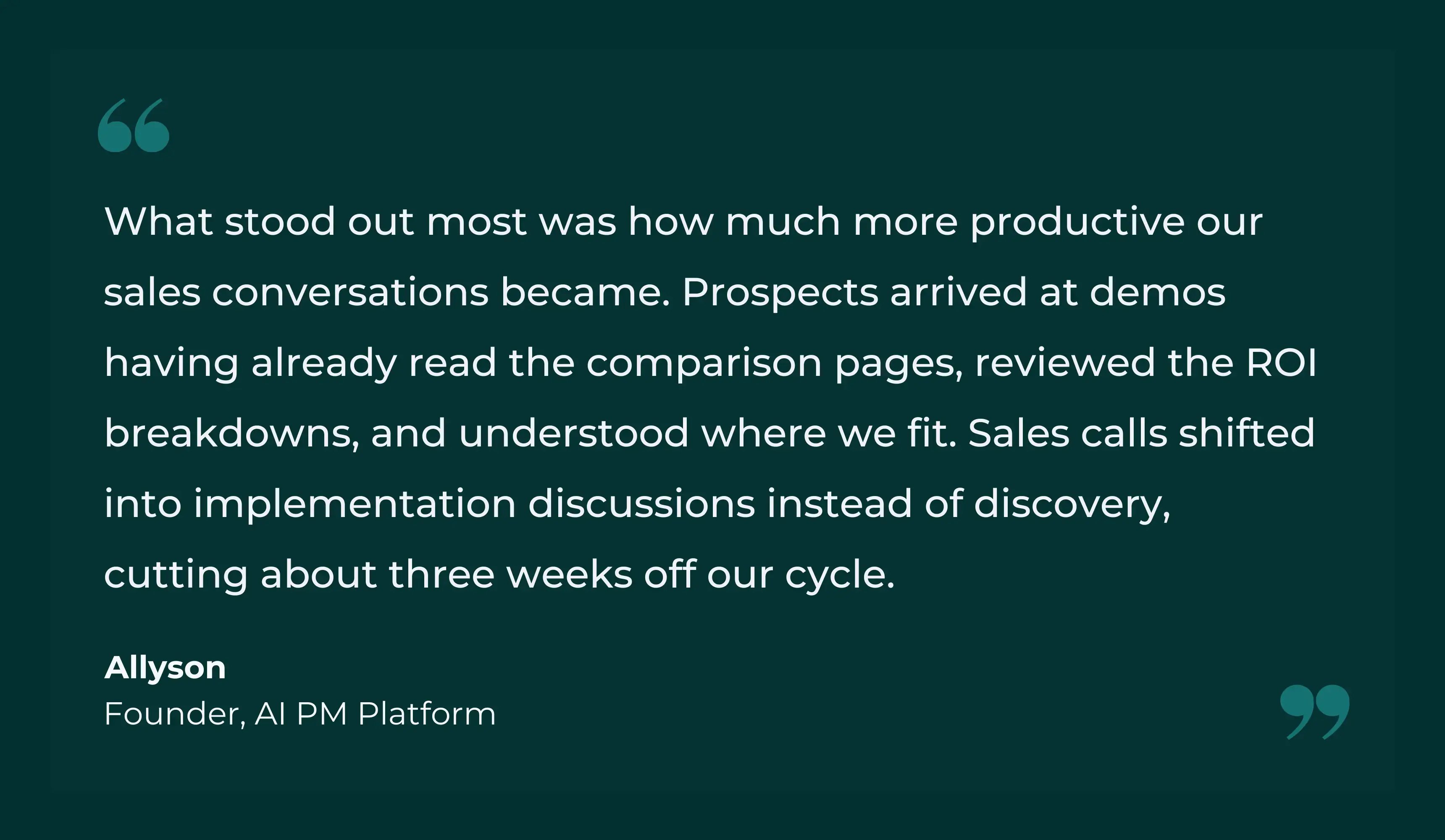
- **Phase 3: Buyer enablement at scale.** Comparison pages, ROI guides, and implementation content gave ICP-fit prospects everything they needed to make an internal business case before ever speaking to sales.
**Impact (within one quarter):**
- Demo signups up **178%**
- Trial-to-paid conversion up **62%**
- CAC down **38%**
- Sales cycles shortened by ~3 weeks
****
[**Read the full case study here.**](https://www.seo-growup.com/ai-pm-platform-case-study)
## FAQs
### Can’t I just hire a consultant to set the strategy and an agency to execute? Why do I need a fractional lead?
You can. And for some companies, that’s the right answer, especially if you have a strong internal PMM or content lead who can manage the translation between consultant recommendations and agency execution.
The problem is the gap. Consultants operate at the strategic layer. Agencies operate at the execution layer. Unless someone internal is managing the handoff, recommendations get lost, context gets dropped, and accountability diffuses. A fractional lead closes that gap, they own both layers, which is why their cost is usually higher than either alone.
### How do I evaluate a fractional SEO lead before I hire one?
Ask for a 30-minute working session before the formal engagement. Give them access to your GSC, GA4, and one of your recent conversion-rate reports. Ask them to come back with three observations and three recommendations. The quality of that output tells you more than any discovery call.
**Also check:** Have they worked with B2B SaaS companies at your stage? Can they show you [pipeline-level attribution](https://www.seo-growup.com/blog/measuring-saas-seo-roi) from a previous engagement, not just traffic charts? Do they speak the language of revenue, or the language of rankings?
### What if we hire an agency and it just... doesn’t work?
The [vetting process](https://www.seo-growup.com/blog/hiring-a-b2b-saas-seo-agency-2026)tells you most of what you need to know before engagement.
**Red flags to watch for:** They pitch before asking about your ICP or sales cycle. The proposal looks templated with your logo swapped in. They promise rankings in a fixed timeframe without understanding your competitive landscape.
**Green flags:** Hard questions about your product, deal cycles, and why you lose deals. A custom proposal that references specifics from your [site audit](https://www.seo-growup.com/b2b-saas-seo-audit-guide). Conversations about pipeline contribution, not just traffic. Content samples that demonstrate subject matter expertise and take a clear point of view.
## SEO Agency vs Consultant vs Fractional Lead: Cost Calculator
This calculator lets you **quantify the true Year 1 cost** of each model using your own numbers: retainers, tool stack, and the execution costs that don’t always show up in a proposal.
**How to use it:**
1. Select the agency tier that reflects your current stage
2. Select your consultant engagement type
3. Select your fractional engagement level
4. Adjust tool stack costs if needed
5. Run the calculation and review total cost before your next budget or board discussion
Model Your SEO Total Cost of Ownership
Agency Tier
Tools included. Execution included. No additional headcount required.
Startups: $5,000/mo ($60K/year) Growth/Scaleups: $8,000/mo ($96K/year) Growth Premium: $10,000/mo ($120K/year) Enterprise: $18,000/mo ($216K/year)
Consultant Engagement Type
Note: consultant fees don’t include execution. Add tool stack and freelancer/agency costs on top.
Ongoing Advisory: $3,000/mo ($36K/year) Ongoing Advisory: $6,000/mo ($72K/year) Ongoing Advisory: $8,000/mo ($96K/year) Interim SEO Director: $10,000/mo ($120K/year) Interim SEO Director: $20,000/mo ($240K/year)
Fractional SEO Lead Level
Note: fractional fees cover strategy and management. Execution via agency or freelancers is separate.
Light-touch: $5,000/mo ($60K/year) Core: $11,000/mo ($132K/year) Near-full-time: $20,000/mo ($240K/year)
Annual Tool Stack Cost (Consultant and Fractional only)
Ahrefs, Clearscope, etc. Agencies typically include tools in their retainer.
$
Default: $15,000/year
Estimated Execution Costs (Consultant model only)
Freelancers, content writers, or agency fees needed to implement the consultant’s strategy. Leave at $0 if you have internal capacity.
$
Default: $40,000/year (typical freelancer/content spend)
CALCULATE TOTAL COST
Year 1 Total Cost of Ownership
| Cost Item | Agency | Consultant | Fractional Lead |
| --- | --- | --- | --- |
| Retainer / Fees | $96,000 | $72,000 | $132,000 |
| Tool Stack | Included | $15,000 | $15,000 |
| Execution Costs | Included | $40,000 | Managed separately |
| Setup / Onboarding | Included | Strategy sprint extra | Included |
| TOTAL (Year 1) | $96,000 | $127,000 | $147,000 |
Cheapest Model
Agency
Lowest all-in Year 1 cost at this tier
Consultant True Cost
$127K
Once you add tools and execution, the lean option isn’t as lean as it looks
What This Doesn’t Capture
This calculator shows **direct costs only**. It doesn’t account for management overhead, ramp time, or the opportunity cost of a model that doesn’t fit your stage. The consultant number assumes you have internal capacity to execute, if you don’t, add freelancer or agency costs on top. The fractional number assumes the lead manages execution through others; dedicated agency or freelancer spend sits outside this figure.
*P.S. If the numbers are pointing you toward one model but your gut says another, that tension usually means something. Maybe it’s timing, maybe it’s a gap in your current setup, maybe it’s just not the right quarter to move. Worth talking through.*
[SCHEDULE CONSULTATION](https://www.seo-growup.com/blog/seo-agency-vs-consultant-vs-fractional-lead#book-call)

Author
Muiz Thomas [in](https://www.linkedin.com/in/muiz-thomas-seo/)
Founder & CMO, GrowUp
Muiz leads GrowUp, a B2B SaaS search marketing agency focused on revenue growth. He’s helped clients generate £5M+ in qualified pipeline across construction tech, AI platforms, and enterprise software. Data-obsessive, perpetually overcaffeinated, and holds sales teams more accountable than their own leadership.
The Marketing Brief
by GrowUp
Get monthly GTM strategies, campaign breakdowns, and category trends we’re seeing across high-growth B2B SaaS teams.
Which best describes you? Founder / CEO CMO / VP Marketing Head of Growth / Demand Gen Fractional CMO / Consultant Investor / Board Member
SUBSCRIBE TO THE BRIEF →
### Is your SEO investment actually connected to pipeline growth?
Find out exactly which parts of your funnel SEO is supporting, and which gaps are stalling demos and trials.
[REQUEST YOUR AUDIT →](https://www.seo-growup.com/seo-audit-for-b2b-saas-companies)
Share This Post

We help B2B SaaS teams turn search into a proven revenue channel through GTM-aligned SEO and content.
Get in Touch
The Marketing Brief
by GrowUp
Monthly GTM insights we use to drive SQLs and scale MRR for high-growth B2B SaaS companies.
Email\*
Which best describes you Founder / CEO CMO / VP Marketing Head of Growth / Demand Gen Fractional CMO / Consultant Investor / Board Member
SUBSCRIBE TO THE BRIEF →
### Services
- [B2B SaaS SEO Consulting](https://www.seo-growup.com/seo-consultancy-for-b2b-saas-companies)
- [B2B SaaS Content Marketing](https://www.seo-growup.com/b2b-saas-content-marketing-agency)
- [B2B SaaS SEO Audit](https://www.seo-growup.com/seo-audit-for-b2b-saas-companies)
- [GTM Advisory](https://www.seo-growup.com/go-to-market-advisory-for-b2b-saas)
- [SEO for Startups](https://www.seo-growup.com/b2b-saas-startup-seo-agency)
- [SEO for Scale-Ups](https://www.seo-growup.com/seo-agency-for-b2b-saas-scaleups)
- [SEO for Enterprises](https://www.seo-growup.com/enterprise-b2b-saas-seo-agency)
### Legal
- [Privacy Policy](https://www.seo-growup.com/privacy-policy)
- [Terms & Conditions](https://www.seo-growup.com/terms-and-conditions)
### Resources
- [SEO Partner Hub](https://www.seo-growup.com/choosing-a-b2b-saas-seo-partner)
- [Blog](https://www.seo-growup.com/growup-blog)
- [eBooks & Templates](https://www.seo-growup.com/ebooks-and-templates)
- [GTM Prompt Library](https://www.seo-growup.com/gtm-prompt-library)
- [Past Newsletters](https://www.seo-growup.com/newsletter)
### Company
- [Why GrowUp](https://www.seo-growup.com/why-growup)
- [Success Stories](https://www.seo-growup.com/success-stories)
- [Pricing](https://www.seo-growup.com/b2b-saas-marketing-services-and-pricing)
- [Contact Us](https://www.seo-growup.com/get-in-touch)
×

## Is Your SaaS Invisible in ChatGPT, Perplexity and Other LLMs?
Get a comprehensive AEO & AI Search Audit to see where you rank across LLMs and how to capture AI search traffic.
[VIEW SAMPLE REPORT](https://www.seo-growup.com/blog/ai-search-visibility-audit-sample) [REQUEST AN AUDIT](https://www.seo-growup.com/get-in-touch)
★★★★★
“Hands down the most actionable insights we’ve received.”

Savas Vedova
Founder, Stormkit
[](https://www.seo-growup.com)
Services
Core Services
[**LLM SEO** Get cited in ChatGPT, Perplexity and Google AI answers. →](https://www.seo-growup.com/llm-seo-agency-for-b2b-saas-companies) [**Web Design** High-converting websites for complex B2B products. →](https://www.seo-growup.com/b2b-saas-web-design-agency) [**$4.7M** Content-influenced pipeline generated *Read case study →*](https://www.seo-growup.com/blog/ai-pm-platform-case-study)
More Services
[SEO Audit](https://www.seo-growup.com/seo-audit-for-b2b-saas-companies) [SEO Consultancy](https://www.seo-growup.com/seo-consultancy-for-b2b-saas-companies) [Fractional SEO](https://www.seo-growup.com/fractional-seo-consultancy-for-b2b-saas-companies) [Content Marketing](https://www.seo-growup.com/b2b-saas-content-marketing-agency) [Web Copywriting](https://www.seo-growup.com/b2b-saas-copywriting-agency) [SEO Link Building](https://www.seo-growup.com/b2b-saas-link-building-agency) [All services →](https://www.seo-growup.com/b2b-saas-seo-services)
By Stage
[Startups](https://www.seo-growup.com/b2b-saas-startup-seo-agency) [Scale-Ups](https://www.seo-growup.com/seo-agency-for-b2b-saas-scaleups) [Enterprises](https://www.seo-growup.com/enterprise-b2b-saas-seo-agency)
By Sector
[FinTech](https://www.seo-growup.com/fintech-seo-agency) [HR Tech](https://www.seo-growup.com/seo-agency-for-hr-tech) [EdTech](https://www.seo-growup.com/seo-agency-for-ed-tech) [ConTech](https://www.seo-growup.com/construction-tech-seo-agency)
Strategy / Content / Tech / Growth
### More visibility. More pipeline.
We combine strategy, UX, design and development to create websites that support demand generation, sales and brand growth.
[Explore our approach](https://www.seo-growup.com/why-growup)
Our Work
[Portfolio](https://www.seo-growup.com/web-design-portfolio) [Success Stories](https://www.seo-growup.com/success-stories)
[Pricing](https://www.seo-growup.com/pricing)
[Why GrowUp?](https://www.seo-growup.com/why-growup)
Resources
[Blog](https://www.seo-growup.com/growup-blog)
Hub
[Vetting SEO Partners](https://www.seo-growup.com/choosing-a-b2b-saas-seo-partner) [Audit Engagements](https://www.seo-growup.com/b2b-saas-seo-audit-guide)
[eBooks & Templates](https://www.seo-growup.com/ebooks-and-templates) [GTM Prompt Library](https://www.seo-growup.com/gtm-prompt-library) [Past Newsletters](https://www.seo-growup.com/newsletter) [Glossary](https://www.seo-growup.com/glossary)
[Get In Touch](https://www.seo-growup.com/get-in-touch)
```json
{
"@context" : "https://schema.org",
"@type" : "BlogPosting",
"author" : {
"@type" : "Person",
"name" : "Muiz Thomas",
"url" : "https://www.seo-growup.com/blog/author/muiz-thomas"
},
"dateModified" : "2026-03-02T11:59:57.205Z",
"datePublished" : "2026-02-19T09:34:37.000Z",
"headline" : "How to Choose Between an SEO Agency, Consultant or Fractional",
"image" : [ "https://www.seo-growup.com/hubfs/How%20to%20Choose%20Between%20an%20SEO%20Agency%2c%20Consultant%20or%20Fractional.webp" ],
"mainEntityOfPage" : {
"@id" : "https://www.seo-growup.com/blog/seo-agency-vs-consultant-vs-fractional-lead",
"@type" : "WebPage"
},
"publisher" : {
"@type" : "Organization",
"logo" : {
"@type" : "ImageObject"
},
"name" : "GrowUp"
}
}
```
```json
{
"@context" : "https://schema.org",
"@type" : "ProfessionalService",
"address" : {
"@type" : "PostalAddress",
"addressCountry" : "GB"
},
"alternateName" : "GrowUp SEO",
"areaServed" : {
"@type" : "Place",
"name" : "United Kingdom"
},
"audience" : {
"@type" : "Audience",
"audienceType" : [ "B2B SaaS Founders", "CMOs", "VPs of Marketing", "In-House Marketing Teams" ]
},
"award" : [ "Most Creative SEO Agency - Martech Awards", "SME News Midlands Enterprise Awards" ],
"description" : "Search marketing agency for B2B SaaS companies. We help teams turn organic and AI search into a fully accountable revenue channel with clear attribution to demos, pipeline, and measurable MRR.",
"email" : "mailto:hello@seo-growup.com",
"founder" : {
"@type" : "Person",
"name" : "Muiz Thomas"
},
"hasOfferCatalog" : {
"@type" : "OfferCatalog",
"itemListElement" : [ ],
"name" : "B2B SaaS Growth Services"
},
"knowsAbout" : [ "B2B SaaS SEO", "Search Engine Optimisation", "Content Marketing", "Go-to-Market Strategy", "SaaS Marketing", "Pipeline Generation", "Revenue Attribution", "AI Search Optimisation" ],
"name" : "GrowUp",
"priceRange" : "£3500+",
"sameAs" : [ "https://www.linkedin.com/company/b2b-saas-seo-agency/", "https://www.instagram.com/seo.growup/" ],
"serviceType" : [ "SEO Consulting", "Content Marketing", "GTM Advisory", "SEO Audit" ],
"slogan" : "Organic & AI Search Programs Built to Deliver SQLs, Pipeline and Measurable MRR",
"url" : "https://www.seo-growup.com/"
}
```