What stood out most was the quality of our sales calls. Prospects arrived at demos having already read the comparison pages, run the ROI numbers, knew exactly where we fit. Sales calls shifted into implementation discussions instead of discovery, cutting about three weeks off our cycle.
The Challenge: Growing Search Demand Without the Content or Attribution to Capture Revenue
When Allyson reached out, organic traffic was growing steadily. They had been publishing content consistently for over a year, and free trials were trickling in every month. If you only looked at surface-level marketing metrics, everything appeared healthy.
But revenue wasn’t keeping pace with traffic.
When we looked under the hood, we found a homepage conversion rate of just 1.8%. That meant 98.2% of the traffic Allyson’s team worked so hard to acquire was bouncing. Worse, of the few who did start a free trial, only 12% eventually moved to a paid plan.
Instead of jumping straight into producing more blog posts, we spent two weeks running a full diagnostic across their inbound funnel.
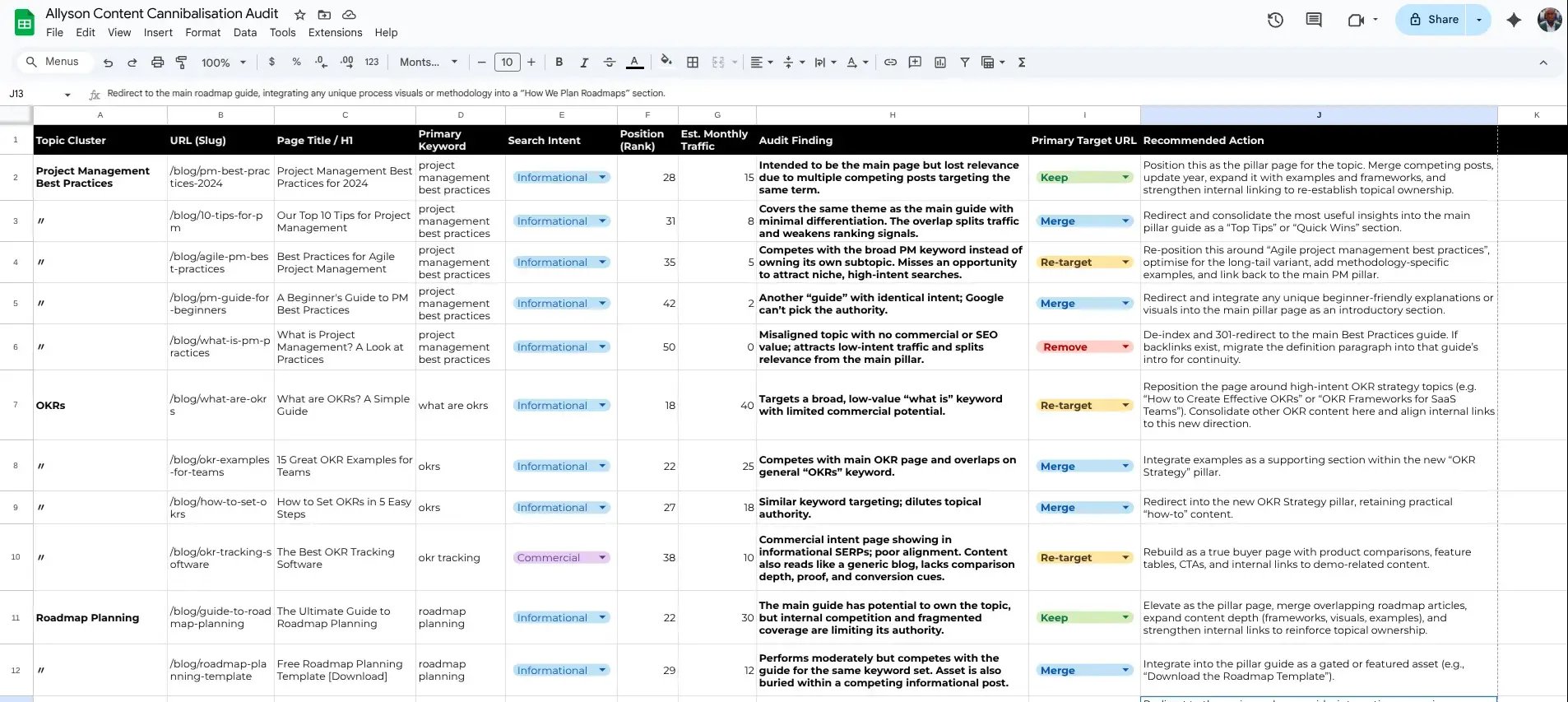
When we pulled everything together, three things stood out:
We had one quarter to fix the foundation, shift the focus to high-intent buyers, and prove revenue impact.
The Solution: Consolidated Content and Built Bottom-Funnel Guides for Sales
We mapped out a quarterly roadmap to clean up the existing ecosystem, build the bottom-of-the-funnel (BOFU) assets the sales team desperately needed, and implement a tracking setup that actually measured revenue.
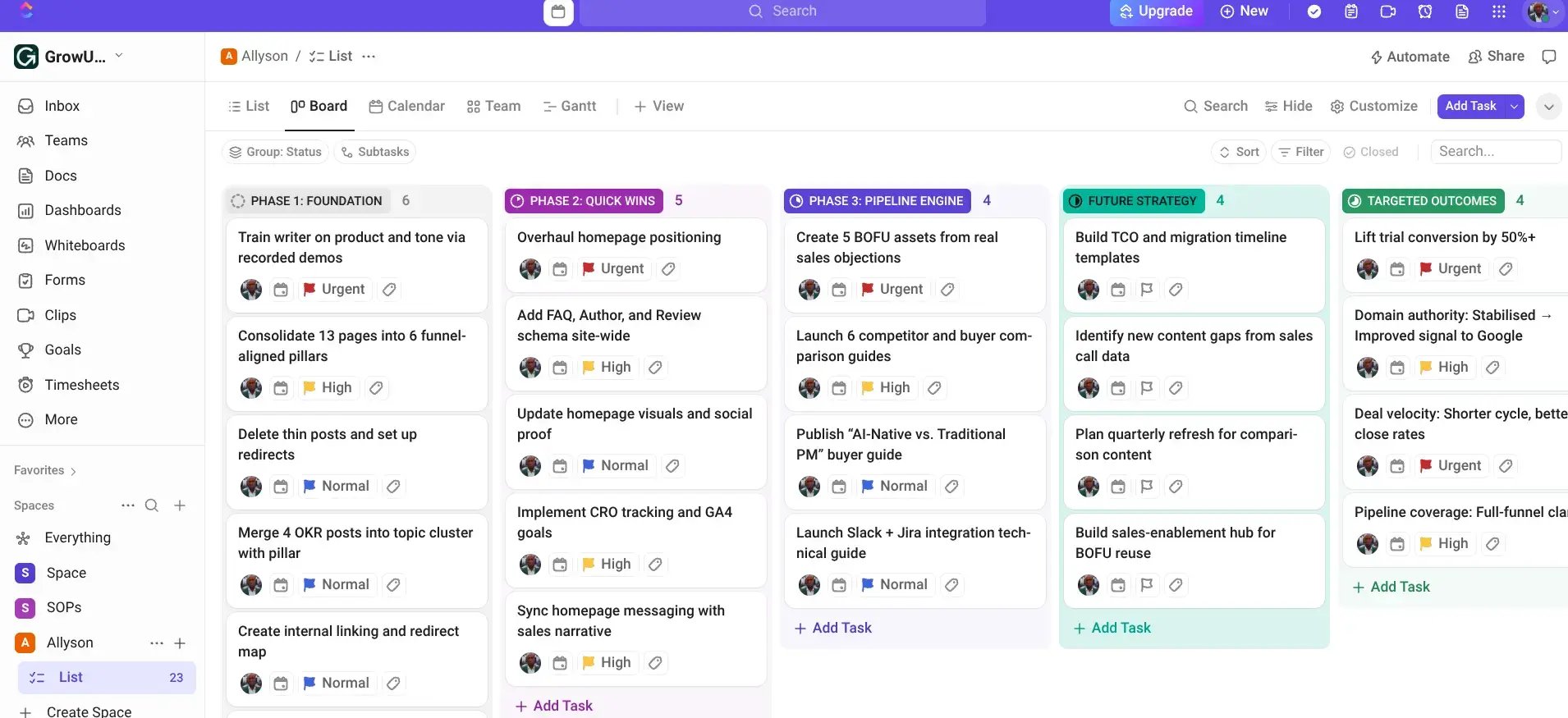
Consolidated Content to Build Search Authority
We also added FAQ, Author, and Review schema site-wide to ensure LLMs and search engines could easily pull from their platform as a credible source.
Result: Rankings stabilised in just three weeks. Because the content was now comprehensive, the sales team actually started sending the new OKR pillar to late-stage prospects to handle objections.
Interviewed Sales to Build BOFU Content for the Buying Committee
Top-of-funnel content (“What is a roadmap?”) brings in traffic, but it doesn’t move a $25k deal through procurement. When you sell to a committee, the fastest path to revenue is creating content that answers the exact questions Finance and the CTO are asking on the backend.
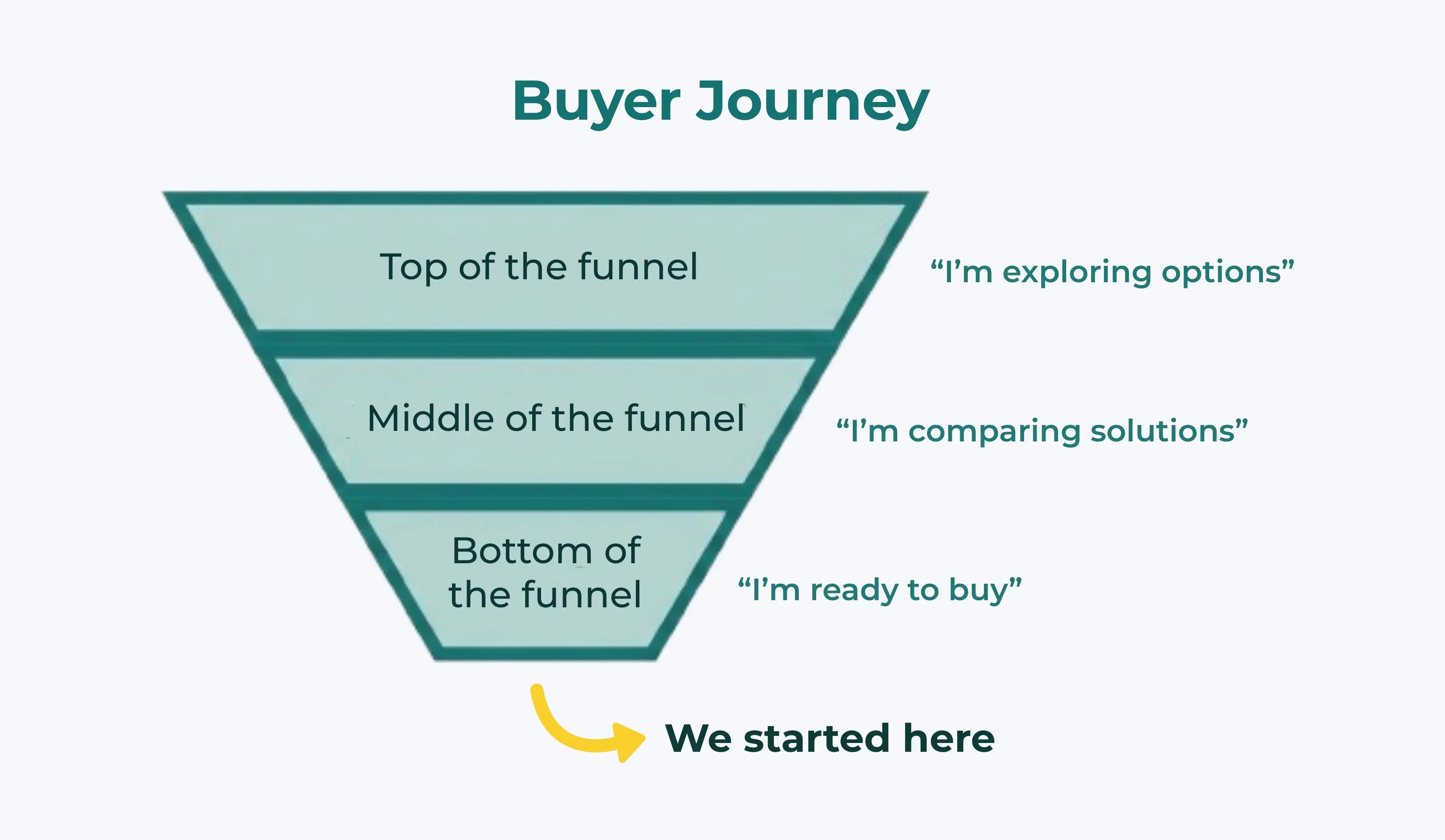
So before briefing a single article, we sat down with the sales team and went through CRM notes and demo recordings, looking for the same objections coming up again and again. We also had a writer shadow the product team for a full week: demo calls, support tickets, internal walkthroughs, instead of working from a single interview and a set of notes.
We then mapped every single asset to a specific sales stage, giving the Account Executives a playbook of what article to send, and when to send it.
Leveraged Competitor Search Volume By Publishing High Intent Alternative Pages
Generating $4.7M+ In Pipeline and Proving ROI With AttributeIQ
We’d set specific targets at the outset: double demo bookings, increase trial conversion by at least 40%, bring CAC down by at least a third.
Six to nine months into the engagement, we’d hit every benchmark, and in some cases, exceeded them.
$4.7M
Content-Influenced Pipeline
189 qualified enterprise demo conversions directly tied to our content ecosystem at a $25k average contract value, tracked over a 9-month attribution window.
Monthly Demo Signups
Scaled qualified requests from 23 to 64 per month within 9 months of launch.
Trial-to-Paid Conversion
Moved trial activation from 12% to 19% by educating buyers upfront.
Customer Acquisition Cost
Scaled high-intent inbound acquisition without reliance on ad spend.
Deal Velocity
Demo-to-close jumped from 23% to 37% as prospects arrived educated
How We Proved the Revenue Impact
GA4 operates on a last-touch model, meaning when an enterprise prospect books a demo on /pricing or /demo, GA4 credits 100% of that conversion to the final form page. Everything that happened before, the articles they read, the comparisons they studied, completely disappears.
To fix this, we plugged Allyson’s ecosystem into AttributeIQ, our multi-touch revenue attribution software that all of our agency clients get complimentary, full-platform access to throughout our engagement.
Here’s what one of Allyson’s actual closed-won buyer journeys looked like inside AttributeIQ, after we connected it to HubSpot:
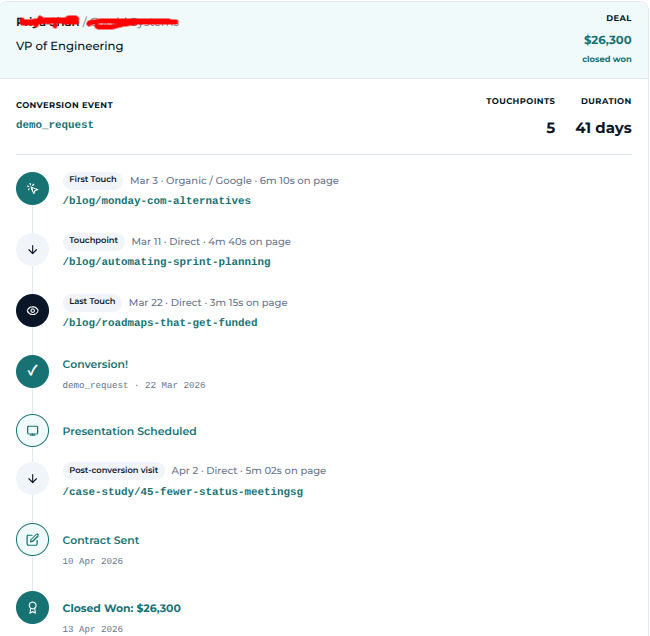
Take the Monday.com alternatives page we built early on. In GA4, that page either shows zero conversions, because the visitor didn’t convert in the same session, or it gets buried under whatever page they happened to be on when they filled out the form. There’s no way to see it actually started a $26k deal.
But with AttributeIQ, we could see the prospect first discovered us through that alternatives guide, then came back to the sprint planning automation piece. Her last touch was the CFO presentation template from the roadmaps guide. She booked a demo, and 13 days later, signed the contract.
That’s one deal, and we had 189 of them.
That gave Allyson a much simpler story to take to the board: here are the customers, here are the journeys they took, here is the content they interacted with, and here is the revenue attached to those deals.
Turning SEO Into a Revenue Channel
We’re proud of what we built with Allyson. When they came to us, organic search was generating traffic, but the content wasn’t doing enough to turn that demand into pipeline, and they had no clear way to prove its commercial impact.
Nine months later, SEO was generating qualified enterprise demand, supporting sales conversations, and influencing $4.7M in pipeline.
If your B2B SaaS company is generating search traffic but struggling to turn it into pipeline, or you simply can’t see what your SEO is contributing to revenue, we can help you figure out what needs to change. Get in touch today.