
Before hiring a B2B SaaS content writing agency, read its published work and speak to the people responsible for delivery. Find out how it researches technical topics, handles feedback and measures leads or pipeline. Then test the relationship with one paid article before committing to regular ongoing production.
How Should You Evaluate a B2B SaaS Content Writing Agency?
One thing I’ve learned from working on B2B SaaS content is that good writing is only part of what makes an agency worth hiring.
You also need people who can understand your product, ask the right questions, work with your internal team and produce content without needing someone to rewrite every other paragraph.
And unfortunately, it’s difficult to judge any of that from an agency’s website or a 30-minute sales call.
That’s why I’d recommend looking at four things before signing a contract:
1. Review Their Portfolio
I’d start with the portfolio. It’s probably the easiest way to get a feel for an agency’s writing before you spend any time speaking to them.
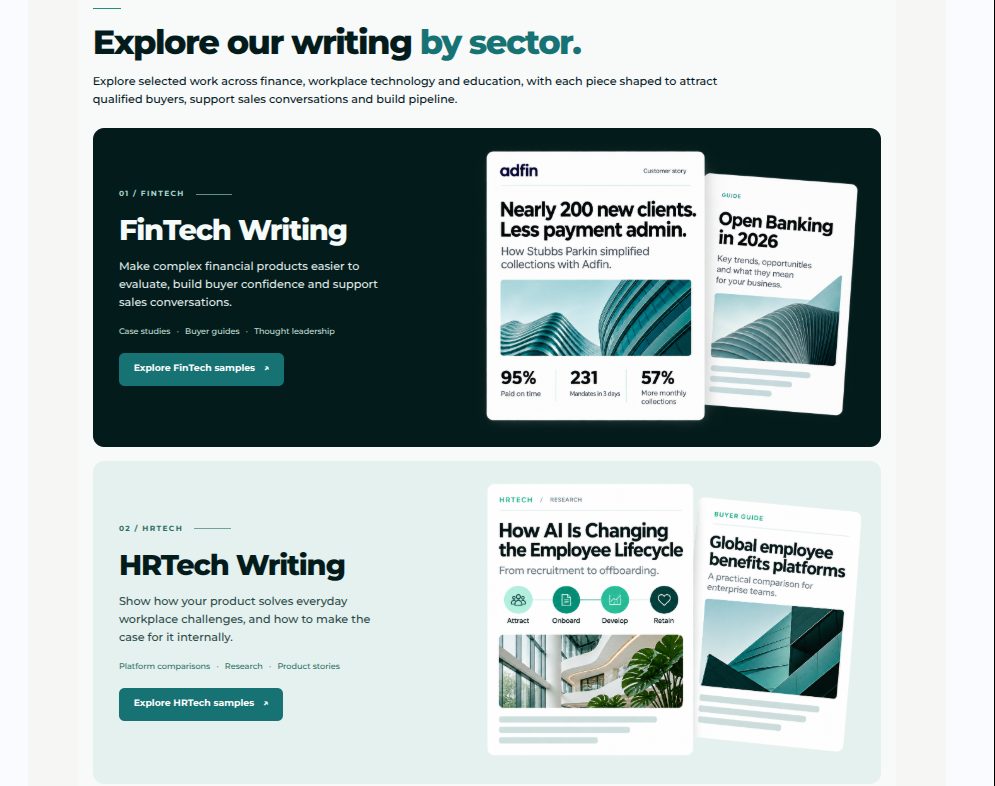
But don’t just skim the headlines or look at the logos on their website. Open a few articles and actually read them. Ideally, find three pieces covering topics close to your industry or the kind of content you’re planning to commission.
Here’s what I’d pay attention to:
- Industry experience: Have they written about products similar to yours? A writer who’s covered payment infrastructure will probably have an easier time understanding another FinTech product than someone who’s only written lifestyle content.
- Content formats: Can they write comparison pages, buyer guides and case studies, or is everything a general blog article?
- Quality of research: Do they explain complicated subjects clearly, use credible sources and include details that suggest they’ve done more than a quick Google search?
- Writing quality: Does the content sound natural? Can you follow the argument without rereading paragraphs?
- Recent work: Check when the articles were published. I’d put more weight on work completed in the past year than samples from several years ago.
2. Review Their Editorial Process
One of the things I’d want to avoid is hiring a content agency only to discover that my team still needs to do half the work.
You send over a brief, wait two weeks, and receive an article that needs another round of research and several technical corrections.
At that point, you haven’t really outsourced much.
Before hiring, ask the agency to walk you through what happens from the moment you commission an article to the point it’s ready to publish.
To give you an idea of what this looks like in practice, here’s how we handle content production at GrowUp, from the first brief to the finished article.
| Stage | Our Approach at GrowUp | Client Deliverables |
|---|---|---|
| 1. Discovery & Briefing | Every piece starts with alignment. We dig into your product, audience and sales priorities, then lock in the topic, buyer intent and desired outcome before production begins. | An agreed content brief covering the angle, audience, structure and key requirements. |
| 2. Research & Strategy | We analyse product documentation, industry research, competitor content and relevant customer insights. Where necessary, we consult your subject-matter experts to strengthen technical accuracy. | A research-backed content direction, supported by credible sources and relevant product insights. |
| 3. Content Development | We develop the article structure, build the narrative and write with your buyers' questions and objections in mind. Search intent, SEO and conversion opportunities are incorporated throughout. | A complete article draft with clear messaging, supporting evidence and natural product positioning. |
| 4. Editorial & Quality Assurance | We review the draft for factual accuracy, clarity, logical flow, source credibility and brand consistency. | An internally reviewed draft, ready for your team's feedback rather than another round of basic editing. |
| 5. Revisions & Final Delivery | We incorporate your consolidated feedback, complete final quality checks and prepare the agreed custom visuals, SEO metadata and supporting assets. | A publication-ready article with final copy, metadata and visuals, requiring minimal additional work from your team. |
3. Know Who’s Writing
I’d always ask to see work from the actual writer assigned to the account.
An agency might have an excellent portfolio, but that doesn’t necessarily tell you who produced those articles or whether the same people are still working there.
There are four things worth confirming:
- Writer: Who will produce your content, and can you see samples?
- Experience: Have they covered similar SaaS products or technical subjects?
- Editor: Who checks their work before it reaches your team?
- Continuity: What happens if your regular writer becomes unavailable?
I don’t think it matters much whether the writer is an employee or a freelancer, provided the agency has a reliable way to select, manage and review their work.
4. Understand How They Report
I’ve seen plenty of content reports filled with rankings and traffic graphs. Those numbers are useful, but they don’t answer the question most SaaS marketing leaders eventually get asked: what is this content doing for the business?
That’s why I’d recommend asking how the agency measures performance before you hire them.
To give you an example, at GrowUp, we use AttributeIQ, an attribution platform we built ourselves, to track what happens after someone reads an article. We can see how content contributes to demo requests, sales opportunities and eventually revenue, rather than reporting on traffic alone.
What Questions Should You Ask Before Hiring a B2B SaaS Content Writing Agency?
By the time you’re speaking to agencies, you’ve probably read a few samples and formed an opinion about who seems like a good fit.
This conversation is where I’d try to understand what working with them will actually involve.
Here are 15 questions I’d recommend asking, grouped into three areas.
Questions About Industry Experience and Product Knowledge
You don’t need an agency that's worked with every company in your category.
But you do need writers who can get up to speed without relying on your marketing team to explain everything.
I’d ask:
- Which companies have you worked with that are similar to ours, and what did you produce for them?
- How would you approach researching our first article?
- What happens when you’re assigned a topic you haven’t covered before?
- How do you decide which topics are worth creating content around?
- What would you need from our team during the first two weeks?
I’d pay particular attention to the second question.
A good answer might involve reviewing your product docs, speaking to an SME and looking at the questions your sales team regularly gets asked.
Questions About Deliverables, Timelines and Revisions
This is where I’d encourage you to get very specific, particularly if you’re comparing agencies with different pricing structures.
Two agencies might both quote £1,000 for an article, but one includes research, editing, visuals and revisions while the other only covers writing.
Ask:
- What’s included in your fee, and what would we pay for separately?
- How many revision rounds are included, and what happens if an article needs a substantial rewrite?
- How quickly can you deliver an article once the brief is approved?
- Are expert interviews, research, visuals and publishing included?
- What happens if the finished article doesn’t meet the agreed brief?
I’d want these answers documented before signing anything.
Not because I expect the relationship to go badly, but because unclear expectations have a habit of becoming problems halfway through a project.
Questions About Communication and Internal Team Involvement
I think this is the part buyers sometimes underestimate.
You might find an agency with excellent writers and reasonable pricing, but if every article requires several meetings, constant follow-ups and three rounds of corrections, the arrangement can become difficult to manage.
I’d ask:
- Who will be our main point of contact, and how will we communicate?
- How much time will you need from our marketing and product teams?
- How do you collect feedback when several stakeholders are involved?
- How often will we review content performance?
- What are your contract terms and required notice period?
Why You Should Test an Agency Before Committing Long-Term
I’ve always thought a paid trial is one of the best ways to find out whether a content agency is right for your business.
You can review portfolios, ask all the right questions, but there’s still a lot you won’t know until you’ve actually worked together.
Thats why I’d recommend starting with one paid assignment before agreeing to a three- or six-month retainer.
Here’s what a good trial looks like.
1. Choose a Real Assignment
If you’re hiring an agency to produce technical buyer guides, product comparisons and case studies, asking for a generic article on the benefits of SaaS won’t tell you much about their ability to handle the actual work.
Choose something already on your content calendar, ideally a topic that requires some research and a reasonable understanding of your product.
2. Provide a Proper Content Brief
One thing I’d be careful about is judging an agency against requirements you never communicated.
If you want the article to address a particular buyer objection, reference your product’s capabilities or avoid certain claims, those details should be in the brief.
You don’t need to write the article for them, but you should provide enough context for them to understand what success looks like.
Here’s what I’d include:
| Brief Element | What to Provide |
|---|---|
| Topic and objective | What the article should cover and what you want it to achieve. |
| Target audience | The buyer’s role, level of knowledge and main concerns. |
| Search intent | The primary keyword and what readers are trying to find. |
| Product context | Relevant documentation, capabilities and positioning. |
| Competitor references | Companies or alternatives the article should consider. |
| Brand guidelines | Tone, terminology and examples of writing you like. |
| Editorial requirements | Word count, sources, visuals, SEO and formatting expectations. |
| Timeline | Agreed deadlines for the first draft, feedback and final delivery. |
3. Evaluate the Entire Process
The finished article matters, obviously, but I wouldn’t judge the trial on writing quality alone. I’d also look at how much time your team spent supporting the work and whether the agency delivered what was agreed.
Here’s a simple scorecard you can use:
| Evaluation Area | What I’d Look For | Score |
|---|---|---|
| Product understanding | Did they explain your product accurately without needing constant clarification? | /5 |
| Research quality | Was the article supported by credible sources and relevant industry knowledge? | /5 |
| Buyer relevance | Did it address questions your target customers actually care about? | /5 |
| Writing and structure | Was the article clear, logically organised and appropriate for the search intent? | /5 |
| Editorial quality | Were factual errors, awkward passages and unsupported claims addressed before delivery? | /5 |
| Internal workload | How much additional research, editing and coordination did your team have to handle? | /5 |
| Communication | Did the agency meet deadlines, provide updates and raise issues early? | /5 |
| Feedback and revisions | Did they understand your comments and make the requested improvements? | /5 |
| Total | /40 |
You can score each area from 1 to 5, with 1 indicating substantial problems and 5 indicating excellent performance.
4. Decide Whether to Continue
Once the article is complete, I’d have a short review with the agency rather than making the decision based entirely on your score.
Discuss what worked, where the process slowed down and what you’d want to change for the next assignment.
I’d focus on three questions:
- Would we publish this article? Is the final work accurate, useful and consistent with our standards?
- Would the process work at scale? Could we comfortably manage four or eight articles a month using the same approach?
- Would we trust this team with more responsibility? Have they demonstrated enough judgement, reliability and product understanding to work with less direction?
If the answers are positive, you’ve got a reasonable basis for discussing a longer engagement. If the writing was strong but the process needs adjusting, you might agree on clearer briefs, different review stages or a second assignment before committing.
And if the trial exposed significant problems with accuracy or quality control, it’s better to discover them after one article than three months into a retainer.
Ready to Hire a B2B SaaS Content Writing Agency?
By this point, you should have a good idea of what to look for in a B2B SaaS content agency, which questions to ask and how to assess whether the working relationship is right for your team.
My advice would be to keep the next step simple. Find an agency whose work you trust, give them a real assignment and see how they handle it before committing to a longer engagement.
If you’re still considering agencies, GrowUp is one option worth looking at. We specialise in B2B SaaS content across FinTech, HRTech and EdTech, and you can review our work here.
Our articles start at £950, while our monthly programme starts at £3,400 for four articles. Most clients begin with one article, so you can score our research, writing and editing against the criteria in this guide before deciding on more.
If that sounds like a sensible starting point, get in touch with GrowUp.
FAQs
When should a B2B SaaS company hire a content writing agency?
How do I know if my SaaS company is ready to outsource content writing?
Should I hire an in-house content writer or outsource to an agency?
Should I hire a B2B SaaS content writing agency or a freelancer?
Is a specialist B2B SaaS content agency better than a generalist agency?
Should I hire separate agencies for SEO strategy and content writing?
Who owns the content after a B2B SaaS writing agency delivers it?
How long does it take to onboard a B2B SaaS content writing agency?