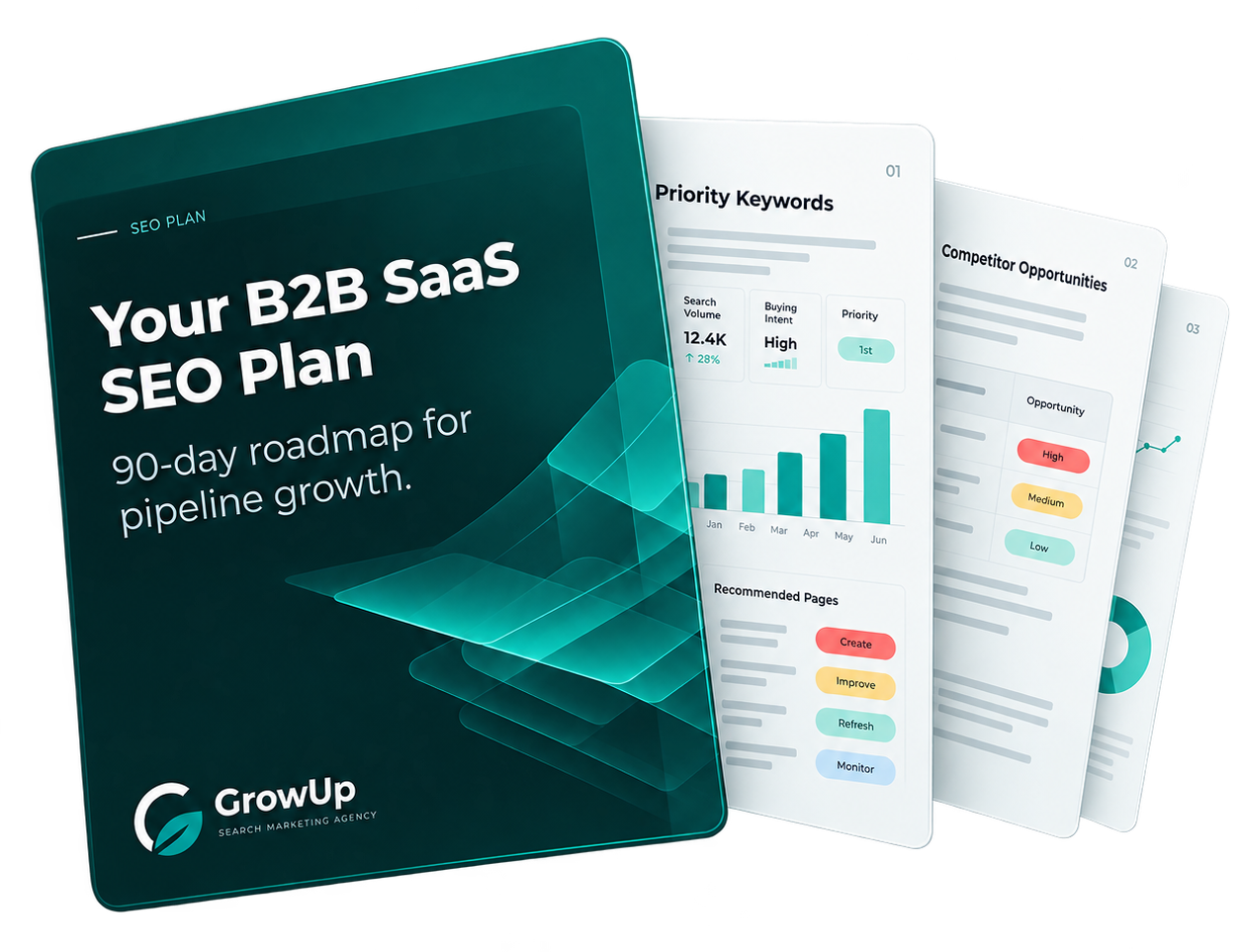
• Our B2B SaaS SEO discovery process takes 14 days and costs £3,500. We begin with a 60-minute product and GTM review and finish with a 90-minute presentation of our findings and recommended execution plan.
• Your team only needs to attend two meetings, totalling 2.5 hours. We handle the keyword research, competitor analysis, content and technical audits, AI search visibility assessment, and 90-day planning.
• You receive a complete research workbook, executive strategy deck, and prioritised 90-day roadmap. All three are yours to keep, whether you continue with GrowUp or execute the recommendations internally.
When you hire most B2B SaaS SEO agencies, your first thirty days disappear into a black hole of “onboarding.”
You wire the first invoice, spend four weeks answering basic product questions, then watch your quarterly pipeline targets tick down while zero pages get shipped or tied to revenue.
At GrowUp, we flipped that model on its head.
Before we write a word of copy or build a single link, we run a 14-day SEO & GEO Discovery Sprint. By day one of execution, we’ve mapped your entire search universe, found which pages are leaking pipeline, seen how ChatGPT and Perplexity frame your category, and isolated the exact bottom-of-funnel plays that drive closed-won ARR fastest.
What a Proper B2B SaaS SEO Discovery Process Is and What It Isn’t
I’ve seen what happens when an agency starts publishing content before properly understanding the business. Three months in, there are new articles, improved rankings, and a report full of green arrows. But when someone asks which pages are bringing in qualified pipeline, nobody has a convincing answer.
That’s exactly what our discovery process is designed to prevent. It’s a separate, paid two-week engagement where we examine your product, sales process, existing pages, competitors, and CRM data before deciding where your SEO budget should go. You leave with a 90-day plan that spells out what we’ll build, what we’ll fix, and how we’ll measure its contribution to pipeline.
How the Two-Week Discovery Process Works From Start to Finish
We need 2.5 hours of your team’s time across two meetings. Everything else, including keyword research, technical reviews, competitor analysis, and planning, is handled by GrowUp.
| Stage | When | Your involvement | What we do | What you receive |
|---|---|---|---|---|
| 1. Kickoff and product walkthrough | Day 1 | 60-minute call | Review your product, ICP, sales process, growth targets, and existing SEO activity. Confirm access to analytics, search, and CRM tools. | Agreed scope, target buyers, commercial goals, and data requirements. |
| 2. Research and analysis | Days 2–13 | Tool access and occasional written questions | Audit existing pages, review technical issues, analyse competitors, research buyer keywords, assess AI search visibility, and examine available CRM data. | Prioritised keyword opportunities, audit findings, AI visibility baseline, and page recommendations. |
| 3. Findings and execution planning | Day 14 | 90-minute walkthrough with relevant stakeholders | Explain our findings, review recommended pages and fixes, agree priorities, and walk through the reporting setup. | 90-day roadmap, research workbook, executive summary, and attribution measurement plan. |
Step 1: A 60-Minute Review of Your Product and Sales Process
We start every discovery engagement with a live product walkthrough. We’ve found that reviewing a SaaS website alone rarely gives us enough information to understand why customers buy, what slows down deals, or which features matter most during evaluations.
So for the first 35 minutes, we ask you to demonstrate your product the same way you would to a qualified prospect.
What We Cover During the Product Walkthrough
- Product workflows: Which features solve your customers’ biggest problems. We use this to assess potential feature and use-case pages.
- Integrations: Which tools do customers connect to your product, and which systems does it replace? This helps us identify integration and comparison opportunities.
- Switching requirements: What does migration involve, how long does implementation take, and what concerns do prospects raise? These answers inform alternatives and competitor comparison pages.
Understanding Your GTM and Revenue Priorities
Once we understand the product, we move into the commercial details. This is where we establish whether the search opportunities we’re considering are actually worth pursuing.
| What we ask | Why it matters to the SEO plan |
|---|---|
| Who are your best customers, and who should you avoid? | Keeps us focused on industries, company sizes, and buyer roles that fit your product. |
| What is your average contract value and sales cycle? | Helps us estimate the commercial value of qualified leads and set realistic expectations. |
| Which competitors appear most often in active deals? | Gives us a starting point for comparison and alternatives pages. |
| What objections repeatedly delay or prevent purchases? | Reveals pricing, implementation, security, and compatibility questions your content should address. |
| What have you already tried with SEO and content? | Helps us understand previous results and avoid repeating work that failed without investigating why. |
We don’t expect every answer to be available during the call. If your team doesn’t know a particular conversion rate or deal metric, we’ll review the available CRM data during the research phase.
Access and Supporting Materials
After the meeting, we send a short access checklist. Most of the research happens without further meetings, provided we have the following:
| What we request | Access or format | What we examine |
|---|---|---|
| Google Search Console | Read-only | Queries, impressions, clicks, and landing-page performance |
| Google Analytics 4 | Viewer | Organic landing pages, conversions, and engagement |
| HubSpot or your CRM | Appropriate read-only access | Lead sources, lifecycle stages, opportunities, and closed-won deals |
| 5–10 sales call recordings | Recordings or transcripts | Buyer questions, objections, and language used during evaluations |
| Recent closed-won deals | CRM records or exported summary | Customer profiles, deal values, and buying patterns |
| Product positioning documents | Existing decks or documents | Messaging, differentiation, and target segments |
The output of Day 1: a documented understanding of your product, ICP, sales process, and the data available for the remaining discovery work.
Step 2: Finding the SEO Opportunities Worth Pursuing (Days 2–13)
Once we understand your product and commercial priorities, we spend the next 12 days reviewing your search performance, website, competitors, and CRM data.
I work directly with our SEO and content team to identify the opportunities that justify investment, the existing assets we can improve, and the gaps preventing you from capturing relevant demand.
We break the research into five areas, with each informing the priorities in your 90-day roadmap.
1. Customer Research & Keyword Mapping
I’ve worked on SaaS projects where some of the most valuable keywords had barely any reported search volume. That’s why I don’t use volume alone to decide what deserves a page.
We look at the questions coming up in your sales calls, the competitors your buyers are considering, and the searches already bringing people to your site.
Then we organise the relevant opportunities into six categories:
| Keyword group | Example | Page we’d investigate |
|---|---|---|
| Best software | Best employee scheduling software | Software shortlist |
| Alternatives | Deputy alternatives | Competitor alternatives |
| Comparisons | Deputy vs When I Work | Product comparison |
| Pricing and reviews | Employee scheduling software pricing | Pricing or buying guide |
| Operational challenges | Reduce employee scheduling errors | Problem-solving guide |
| Features and integrations | Scheduling software with payroll integration | Feature or integration page |
Before adding an opportunity to the roadmap, we check:
- Relevance: Would your ideal customer realistically search for this?
- Coverage: Do you already have a page that answers the query?
- Feasibility: What would it take to compete with the pages currently ranking?
We also check whether the keyword is attracting the right type of company. There’s little point ranking for searches from freelancers or very small teams if your product is built for organisations with hundreds of employees.
The deliverable: A keyword and page opportunity sheet identifying what to create, what to improve, and which opportunities should come first.
2. Reviewing Competitor Rankings and Missing Commercial Pages
Once we’ve shortlisted the keywords, we compare your current visibility against the competitors ranking for those searches.
We review their content, backlinks, and existing rankings to identify where they’re capturing relevant demand that your website isn’t. We also check which of those opportunities are realistic to pursue based on your site’s current performance and authority.
Here’s the sort of thing we document:
| What our research shows | What we’d recommend |
|---|---|
| Missing comparison coverage: Four competitors rank for relevant alternatives and versus searches, while your website has no dedicated pages. | Cross-check those competitors against your sales pipeline and prioritise the comparison pages with the strongest buyer fit. |
| Untapped integration demand: Competitors have pages targeting integrations you support, including searches with clear purchase requirements. | Recommend new integration pages where there’s relevant demand, or improve existing pages that aren’t ranking. |
| Missing third-party visibility: Competing vendors appear on relevant software directories, review pages, and industry publications where you’re absent. | Identify which websites accept vendor submissions or editorial contributions and include suitable targets in the outreach plan. |
| Existing ranking opportunities: Your product page sits in positions 11–15 for a high-intent search, while competing pages have more complete content and stronger internal linking. | Prioritise improving the existing page, with specific recommendations for content gaps, internal links, and supporting backlinks. |
The deliverable: A competitor opportunity sheet with missing pages, existing pages worth improving, and relevant backlink opportunities.
3. Content Inventory Audit & Quick-Win Opportunities
One thing I always check before recommending a new content programme is whether your existing pages could be doing more.
We use Search Console, GA4, and CRM data to identify pages that already attract relevant buyers but aren’t converting or ranking as well as they should.
Here’s how we assess those pages and decide what to improve:
| Existing page | What we find | What we’d recommend |
|---|---|---|
| Main product page | Ranking in positions 11–15 for a relevant category keyword, with low CTR | Review the title, search intent alignment, product positioning, and internal links |
| Competitor comparison | Outdated feature information and low demo conversion | Update the comparison, verify product claims, and improve demo CTAs |
| Integration page | Relevant impressions but missing setup and compatibility details | Expand the page using product documentation and common sales questions |
| Two overlapping articles | Both target the same query and provide similar information | Assess whether consolidation would improve coverage and reduce duplication |
We don’t automatically recommend rewriting every underperforming page. Some only need technical fixes, some need better content, and others aren’t worth further investment.
The deliverable: A URL-level audit showing which pages to keep, update, consolidate, or fix, with priority changes included in your 90-day roadmap.
4. AI Search Visibility Audit
Next, we check whether your product appears when buyers use ChatGPT, Perplexity, Gemini, and Google AI search experiences to research software.
We use the customer profiles, competitors, and product requirements identified earlier and turn them into a list of buying prompts. We test each prompt, record the responses, and review the sources cited.
Here’s an example of what we document:
| What we test | What we check |
|---|---|
| Best employee scheduling software for multi-location businesses | Whether your product is recommended and which competitors appear |
| Deputy alternatives for enterprise teams | Whether you’re included as an alternative and how your product is positioned |
| Scheduling software with payroll integrations | Whether supported integrations are recognised accurately |
| Employee scheduling software pricing | Whether your pricing is represented correctly and which sources are cited |
We also review third-party websites appearing repeatedly in the responses, including software directories, review platforms, and industry publications.
Where your competitors are mentioned but you’re absent, we check whether the gap relates to missing product information, limited third-party coverage, or content that doesn’t adequately address the buyer’s question.
The deliverable: An AI visibility baseline covering tested prompts, brand mentions, competitor recommendations, cited sources, and prioritised opportunities to improve your coverage.
5. 90-Day Execution Roadmap & AttributeIQ Reporting Setup
With the research complete, we bring the findings together into a 90-day execution plan.
We review each recommendation against its commercial relevance, ranking potential, implementation effort, and the resources your team can commit.
Here’s an example of how we’d structure the first 90 days:
| Timeline | Execution priorities |
|---|---|
| Days 1–30 | Resolve priority technical issues, improve existing commercial pages, and establish reporting baselines |
| Days 31–60 | Publish shortlisted comparison, alternatives, and integration pages |
| Days 61–90 | Expand supporting content, improve internal linking, and pursue relevant industry mentions |
We also review your existing CRM and analytics setup to establish what can be tracked through AttributeIQ, our multi-touch attribution platform.
The reporting plan covers organic visibility, qualified demos and SQLs, influenced pipeline, and closed-won revenue. Where tracking is incomplete, we document the requirements before execution begins.
The deliverable: A prioritised 90-day roadmap covering content, technical fixes, delivery responsibilities, and an attribution plan tied to your pipeline goals.
Step 3: Reviewing Your SEO Strategy and 90-Day Plan (Day 14)
On Day 14, we meet for a 90-minute walkthrough with you and the relevant marketing or revenue stakeholders.
We review the research findings, explain why we’ve prioritised certain opportunities, and discuss the proposed execution plan against your budget, internal resources, and pipeline targets.
You’ll receive three documents:
| Document | What it contains |
|---|---|
| SEO Research Workbook | Your prioritised keyword opportunities, competitor gaps, content audit, technical recommendations, and AI search visibility findings. |
| Executive Strategy Deck | A summary of our findings, recommended investments, and proposed budget options for internal review. |
| 90-Day Execution Roadmap | A breakdown of what we’ll deliver, when each activity is scheduled, who is responsible, and how performance will be measured. |
We’ll also review the attribution requirements and agree on any adjustments before execution begins.
Everything is yours to keep, whether you continue working with GrowUp or implement the recommendations internally.
What the Discovery Engagement Costs and What Comes Next
We charge £3,500 for the full two-week discovery process, separate from any ongoing SEO retainer. That includes everything from the initial product walkthrough to the final research workbook, strategy presentation, and 90-day roadmap. Our pricing page explains the different monthly programmes.
Once we’ve reviewed the findings together, we’ll recommend the level of ongoing support we think makes sense for your business. That could be a focused £3,500 monthly programme or a larger engagement covering content, technical SEO, link building, and AI visibility.
We usually advise starting with three months, with the scope and terms agreed before work begins. And if you’d rather have your internal team execute the recommendations, that’s fine too. Everything produced during discovery is yours to keep.
Before You Commit to Another B2B SaaS SEO Retainer
If you’re reviewing your SEO budget or considering a new agency, I’d recommend establishing what actually needs to be done before committing to another monthly retainer.
That’s what our discovery process is designed to help with. We’ll review your current performance, identify the opportunities worth pursuing, and give you a prioritised 90-day plan.
You can book a 30-minute introductory call to discuss your current SEO priorities and whether discovery makes sense for your business.