
Hiring the right B2B SaaS SEO agency starts with clarity on your growth story. Before you send a single RFP, get brutally clear on what success looks like and what resources you actually have. Then, look for agencies that connect their strategy to your north-star KPI, whether that’s SQLs, pipeline, or CAC efficiency.
The best ones bring structured thinking: they’ll challenge your assumptions, work cross-functionally with product and growth, and report back in revenue terms. The moment you start hearing “X blogs, Y backlinks,” you’re talking to the wrong partner.
Before You Talk to Agencies: Define What Success Actually Looks Like
Hiring an SEO agency usually feels heavier than it should. Not because it’s complex, but because everyone’s trying to protect themselves: marketing from missed targets, finance from wasted spend, and leadership from another initiative that “looked good on paper.”
That weight usually comes from ambiguity. When you don’t have a firm grip on your own growth motion, you’re forced to hope the agency has all the answers. They don’t, at least not yet.
To move from “protection” to “performance,” you need to answer these three questions to ensure you aren’t just buying another expensive line item:
| Question | Why It Matters | What to Define |
|---|---|---|
| What’s your north-star metric? | Growth teams love obsessing over traffic numbers, but leadership wants to see how SEO contributes to revenue. | Be specific: Are you focused on net new MRR? Expansion revenue? Reducing churn? Improving your LTV:CAC ratio? Pick one primary metric and own it. |
| What’s your actual growth motion? | The right SEO strategy depends on how you acquire and convert customers. | If you’re PLG, your agency needs to understand self-serve buyer journeys: how people research, compare, and convert without touching sales. If you’re enterprise, you need content that nurtures multiple stakeholders over 6-12 month cycles and supports ABM. |
| What internal resources can you actually commit? | Agencies build their scope and pricing based on your capacity. Getting this wrong upfront leads to missed deadlines and frustration on both sides. | Map out who you’ve got: content writers, product marketers, devs who can implement technical fixes, RevOps analysts who can connect the dots to revenue. Be realistic about bandwidth. |
Do this exercise before you reach out to anyone. Write it down. Put it in a doc.
At GrowUp, we ask clients to fill this out before our first call, it sounds simple, but it cuts through weeks of back-and-forth and gets us aligned from day one.
The Step-by-Step Hiring Process
The following process adapts our hiring framework to a SaaS context. Each stage includes actions for your team and questions to ask agencies.
1. Define Success Before You Define Scope
Most RFPs I see open with a list of deliverables: “We need 12 blog posts and 5 backlinks/mo.” That usually puts the conversation on the wrong footing.
Instead, start with the outcome. Are you trying to generate 30% more SQLs from organic over the next year? Reduce CAC by shifting more pipeline to organic? Build credibility in a new segment before your fundraise?
Once you’ve defined the north-star, scope becomes much easier, and much more honest. You can describe the outcome you need, the limitations you’re dealing with, and the time frame that matters. A strong agency will propose how to get there. A weak one will push a pre-packaged plan.
2. Build a Realistic Shortlist (5-7 Agencies Maximum)
You don’t need to talk to fifteen agencies, five good ones are enough.
Start with specialisation. Do they have real experience with SaaS companies at your stage and motion? Because a $2M ARR PLG startup needs something totally different from a $50M enterprise company. What works for one rarely translates to the other.
Check their own SEO. If they’re not ranking for terms like “SaaS SEO agency” or “B2B content marketing,” that tells you something.
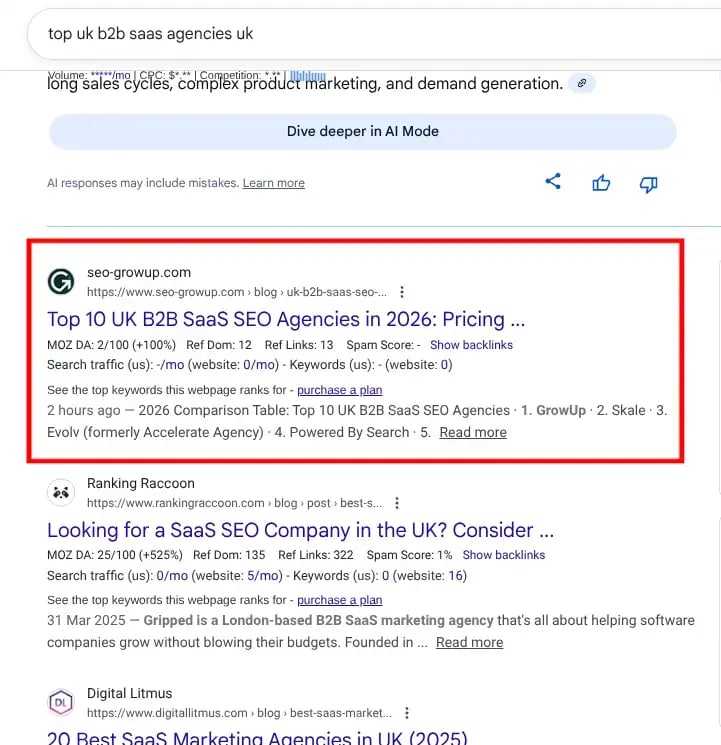
Note: If they’re not ranking, that shouldn’t automatically disqualify them, they might be swamped with client work. But at minimum, their blog should demonstrate the strategic depth you’d expect them to apply to your business.
3. Send a Detailed RFP (Not a Survey)
Your RFP isn’t a procurement formality.
Skip the forty-page questionnaire asking for their five-year company history and insurance certificates. Send a concise document that includes:
| Section | What to Share |
|---|---|
| Business context | Your stage, ARR, growth targets, sales motion, product complexity, and competitive landscape. Give them enough to understand what you’re actually trying to accomplish. |
| SEO state | Current organic traffic, conversion rates, where you rank (or don’t), and what you’ve tried before, including what failed and why. |
| Success criteria | Be specific: “Drive X SQLs at Y cost per lead” or “Capture 15% organic share in [segment] within 12 months.” Use the metrics your board actually cares about. |
| Constraints | Budget range, team capacity, technical limitations, timeline. |
| Questions | 10-15 open-ended prompts that force them to demonstrate strategic thinking, not just recite case studies. (More on these below.) |
The agencies that come back with thoughtful, specific responses tailored to your business, those are your finalists. The ones that send back a slightly customised version of their standard proposal, those go in the “no” pile.
For RFP templates, contract negotiation guides, and agency vetting checklists, check out our resource center for selecting the right B2B SaaS SEO partner.
4. Conduct Working Interviews
Schedule 60-90 minute working sessions with your finalists. Not presentations, actual conversations. Bring your head of growth, content lead, maybe your product marketing manager. Watch how the agency engages with them.
Ask them to walk through how they’d approach your specific situation. What would they audit first? What are your biggest SEO gaps based on what they’ve seen so far? Where would they focus in the first 90 days?
The strong ones will ask as many questions as they answer. They’ll want to understand your customer research process, how product and marketing work together, what’s blocked past SEO efforts. If they push back on something you’ve said, that’s actually a good sign, it means they have a point of view.
5. Evaluate and Compare (With a Scorecard)
You’ve probably talked to 3-5 finalists by now. They all seem smart. They all have good case studies. So how do you decide?
Use a weighted scorecard. Not all criteria matter equally; don’t pretend they do.
| Criteria | Weight | What to Look For |
|---|---|---|
| SaaS specialisation | 20% | Do they understand subscription economics, buyer journeys, PLG vs. sales-led dynamics? Can they articulate how SEO ties to MRR, churn, expansion revenue? |
| Strategic depth | 25% | Are they bringing insights or just executing what you tell them? Do they understand your competitive landscape? Can they explain trade-offs and priorities? |
| Technical capability | 15% | Can they handle schema, JavaScript rendering, international SEO, migration support? Do they know how to work with product and eng teams? |
| Metrics and reporting | 20% | Will they track SQLs, pipeline, and revenue, or just rankings and traffic? Can they integrate with your CRM and analytics stack? Do they have experience with attribution modeling? |
| Team composition | 10% | Who will actually work on your account? What’s their background? How do they handle transitions if someone leaves? |
| Cultural fit | 10% | Do they communicate the way you do? Are they proactive or reactive? Will they challenge you when you’re wrong, or just take orders? |
Score each agency on a 0-3 scale for each criterion (0 = weak, 1 = acceptable, 2 = strong, 3 = exceptional). Multiply by the weight. Add it up. The math gives you a starting point; your judgment makes the final call.
Questions to Ask Before Outsourcing SEO to a B2B SaaS Agency
Below is a curated list of questions covering strategy, metrics, technology, communication and team structure.
On Strategy & Business Alignment
1. “How would you connect our SEO strategy to our growth targets and sales motion?”
-
Strong agencies talk about pipeline contribution, not just rankings. They should ask about your sales cycle, deal size, and how marketing and sales work together before prescribing tactics.
2. “How do you decide what not to prioritise in the first 90 days?”
-
This reveals strategic thinking. Weak agencies promise everything. Strong ones explain trade-offs and why certain high-volume keywords might be the wrong bet for your business model.
3. “What’s your perspective on AI-generated content for a brand at our stage?”
-
You want nuance here, not “AI is great” or “AI is bad.” Look for answers about maintaining expertise and authority (E-E-A-T) while using AI for efficiency where it makes sense.
On Metrics & Accountability
4. “How do you track SEO’s contribution to Pipeline and Revenue, not just traffic?”
-
They should mention CRM integration, multi-touch attribution, and tracking SQLs or opportunities. If they only talk about rankings and sessions, that’s a red flag.
5. “What happens if we don't see results in the first quarter?”
-
Good agencies explain leading indicators: impression growth, click-through rates, branded search volume, and how they’d adjust strategy. Bad ones make excuses or promise it’ll turn around soon.
On Logistics & Team Process
6. “Who specifically will be working on our account, and what’s their background with SaaS companies?”
-
Get names. Ask about tenure. Find out if the person pitching is the person executing. If they’re vague, assume you’re getting the B-team.
7. “How do you typically collaborate with in-house content, product marketing, and product teams?”
-
Strong agencies have structured workflows for briefing internal teams and integrating into your editorial calendar. They should explain how they handle messaging disagreements.
8. “What does onboarding look like, and what do you need from us to succeed?”
-
This reveals process maturity. Good answers include specific asks: CRM access, analytics setup, stakeholder interviews, content audit timelines.
On Technical Capability
9. “What tools do you use, and what access do you need from us?”
-
They should have their own SEO platforms (Ahrefs, Semrush, etc.) but need access to your GA4, Search Console, CRM, and possibly CMS. If they ask for additional tool budgets, understand why.
On Proof & Validation
10. “Can you share a case study where SEO contributed to pipeline growth, not just traffic?”
-
Push for specifics: percentage increase in SQLs, change in CAC, contribution to closed-won revenue. If they can’t provide revenue metrics, ask why.
Bonus: Can you provide two references from clients at a similar stage to us?”
-
Talk to references off-script. Don’t just ask “would you recommend them?” Ask about communication cadence, how they handled disagreements, whether results matched projections, and what they wish had been different.
Sample SaaS SEO RFP Outline
Below is an outline you can use to structure your formal RFP.
Each section should prompt SEO agencies to provide the detail you need to score them objectively.
Request for Proposal: [Company Name] SEO Partnership
| RFP Section | What to Include |
|---|---|
| Company Overview | Brief description of your company, product stage, and go-to-market model. Include your north-star metrics and growth targets. |
| Project Scope & Objectives | Goals (e.g., increase net new MRR, reduce churn, expand into new market). Services required: technical SEO audit, content production, link building, conversion optimization, analytics integration. Time frame and target outcomes. |
| Technical Requirements | CMS, CRM, and analytics platforms in use. Any site migrations, multi-language needs, or app store optimisation requirements. |
| Specific Challenges | Detail any unique obstacles (e.g., “We’re migrating from .io to .com,” or “We’re competing heavily with G2/Capterra for comparison keywords”). |
| Reporting & KPIs | Define how success will be measured (MRR growth, SQLs, LTV:CAC, churn reduction). Request sample reports and dashboards. |
| Budget & Pricing Guidance | Provide a budget range and note whether you prefer retainers, project-based, or hybrid models. |
| Submission Requirements | Deadline for proposal submission. Ask agencies to describe their first 90-day roadmap. Required attachments (case studies, references, etc.). |
Make your RFP clear but not overly restrictive; Being too specific can limit creativity, while asking too many questions can overwhelm agencies.
Your First 90 Days: What to Expect From the Right SaaS SEO Agency
A good RFP process gets you the right partner.
What happens next determines whether you actually get results. Here’s how we structure the first 90 days at GrowUp.
| Timeline | Focus |
|---|---|
| Week 1-2: Audit & Discovery | We run a working kickoff with the people closest to revenue, not just marketing. We talk through how pipeline is really created, where deals slow down, how buyers make decisions, and what leadership is actually judging success on. In parallel, we audit your site and content through a revenue lens to figure out exactly where your best leads are dropping off in the funnel. |
| Week 3-4: Strategy Presentation | You get a 6-12 month plan prioritised by business impact. We identify quick wins (content that can capture active demand now) and strategic bets (authority plays that build long-term compounding value). Every recommendation ties back to your north-star metrics, whether that’s demo volume, SQL quality, pipeline contribution, or deal velocity. |
| Month 2: Execution Begins | Content briefs start flowing. Technical improvements get prioritised with your engineering team. If link building is in scope, outreach campaigns launch. You’ll see consistent forward motion: pages publishing, technical debt clearing, authority building, even if rankings haven’t moved yet. |
| Month 3: First Results Check-In | You won’t see transformative SEO results in 90 days, but you’ll see some leading indicators: pages indexed and ranking, engagement metrics improving, early conversions trickling in. More importantly, you’ll have confidence in the process and visibility into what’s working. |
| Ongoing: Monthly Reporting | Monthly updates tie performance to the KPIs we agreed on: traffic and rankings, yes, but also conversion rates, pipeline contribution, deal quality, and what we’re learning from the data. |
FAQs
How do I know if we’re actually ready to hire a SaaS SEO agency?
How much should I budget for B2B SaaS SEO?
How do we justify an SEO retainer to a CFO who wants immediate ROI?
What’s a major red flag during the hiring process?
Final Thoughts: Make the Decision That Sets You Up for Leverage
Choosing an SEO partner is a decision that dictates your long-term cost of acquisition. Prioritise a team that understands your sales motion and treats organic search as a strategic asset.
And when you do find the right partner, someone who challenges you, brings insights you didn’t have, and cares about your pipeline as much as you do, hold onto them. Great agencies are rare. Poor ones are everywhere.