
If you’re Series A, pre-$5M ARR, and organic is nascent: Hire an agency. You don’t have time to build a team from scratch. Invest $6K–$10K/mo, see traction in 4–6 months, then decide if you want to bring it in-house.
If you’re Series B, $10M–$30M ARR, and organic is 15–30% of pipeline: Go hybrid. Hire one internal strategist ($100K–$120K) who owns the roadmap, then partner with an agency ($72K–$120K) for execution. Total: $192K–$240K annually. You get speed, scale, and control where it counts.
If you’re Series C+, $50M+ ARR, and organic contributes 40%+ of pipeline: Build in-house. You have the budget, timeline, and operational maturity. Hire a Director of Organic Growth, build a team beneath them ($262K–$437K annually), and use agencies for specialised gaps like technical audits or enterprise link building.
If you’re still on the fence, run this little thought experiment: imagine it’s 12 months from now. Organic contributes 25% of pipeline and you hit your number. Which path got you there faster, building a team from scratch, or partnering with people who’ve done this 50 times before?
The answer is usually obvious.
The Total Cost of Ownership
The most common mistake I see CMOs make is underestimating the true cost of an in-house team. The thinking goes: “An agency costs $120k/year. I can hire a great SEO Manager for $100k and lower our cost base.”
In practice, the math rarely works that neatly.
A single hire can’t juggle technical audits, content strategy, thought‑leadership writing, and digital PR at the level your growth targets demand. And when you factor in recruitment fees, benefits (roughly 30 % of salary), training and ramp‑up time, the cost balloons further.
To make this more concrete, here’s what it actually takes to build a small but functional in‑house SEO team.
Building In-House: Full Annual Cost
Here’s what a minimal viable SEO function actually costs for a Series A–C SaaS company (salary data from Glassdoor):
| Role | Base Salary | Benefits (30%) | Tools & Software | Recruiting (10%) | Annual Total |
| SEO Manager (4–6 years exp) | $64,000–$115,000 | $19,200–$34,500 | Included below | $6,400–$11,500 | $89,600–$161,000 |
| Content Manager (2–4 years exp) | $62,000–$101,000 | $18,600–$30,300 | Included below | $6,200–$10,100 | $86,800–$141,400 |
| Link Builder / Outreach Specialist | $44,000–$75,000 | $13,200–$22,500 | Included below | $4,400–$7,500 | $61,600–$105,000 |
| Shared Tool Stack | — | — | $18,000–$24,000 | — | $18,000–$24,000 |
Total Annual Cost: $256,000–$431,400
(Recruiting costs assume 10% of first-year salary per hire. Conservative.)
And this is before you account for:
- Ramp time: Expect a 90-day lag for your SEO lead and 60 days for supporting roles. That’s an entire quarter of overhead with zero market momentum.
- Management overhead: Who’s managing this team? If it’s you, that’s 8–12 hours weekly you’re not spending on broader growth strategy. If you hire a Director of Growth to own it, add another $140K–$170K in annual cost.
- Turnover risk: Average employee tenure is 2 years and 1 month. When your SEO manager leaves, you lose institutional knowledge and spend 3–4 months backfilling. Then the cycle repeats.
Agency Model: Monthly Retainer Pricing
A specialised B2B SaaS SEO agency typically structures pricing around deliverables and outcomes, with fixed monthly retainers that look like this:
| Engagement Model | Monthly Retainer |
What You Get | Best For |
| Startups | $4,000–$6,000 | Technical audit + on-page optimisation, 4–6 articles/month, basic link building | Series A companies validating SEO as a growth channel |
| Growth/Scaleups | $6,000–$10,000 | Comprehensive technical SEO, 8–12 articles/month, active link acquisition, conversion optimisation | Series B scaling organic to 20–30% of new pipeline |
| Enterprises | $10,000–$20,000+ | Full-stack SEO + content + CRO + attribution modeling, dedicated strategist | Series C+ or competitive verticals (fintech, HR tech) |
Annual cost for a Growth engagement: $72,000–$120,000.
That’s 53–83% less than building in-house, with zero ramp time, no benefits or recruiting fees, and the ability to scale up or down with 30 days’ notice.
The “Hidden” Cost Layer
Neither model is as clean as the line items suggest. Both come with friction that affects your budget and your time. Here’s what that looks like:
In-house hidden costs:
- Mis-hire spiral: Get the SEO manager wrong and you’ve just burned 6-9 months plus $80K trying to make it work before you finally pull the plug.
- Skill gaps you didn’t plan for: Your content manager writes well. Great. Can they build programmatic SEO for a 10,000-page product catalog? Probably not. You’ll need contractors or consultants anyway.
- Tool bloat: Every new hire has opinions about tools. Before you know it, you’re paying for Ahrefs, Semrush, Clearscope, Surfer, and three different rank trackers because no one wants to compromise.
Agency hidden costs:
- Context tax: Early on, you’re spending hours explaining your market, your buyer, your positioning. It gets smoother after month three, but the first 60 days feel like a part-time job.
- Implementation dependency: Even full-service agencies need internal stakeholders to approve dev work, provide CMS access, and validate product claims. If your engineering team can’t prioritise SEO tickets or you lack a technical PM to facilitate handoffs, execution slows down.
- Scope creep risk: Without clear boundaries, “quick questions” pile up and your retainer gets diluted. You end up paying $10K/month but only getting $6K worth of strategic execution because half the hours go to reactive Slack support instead of the roadmap you paid for.
Total Year 1 Cost: In-House vs. Agency
When you add everything up, the comparison looks like this:
| Cost Category | In-House Team (Year 1) |
Specialised SaaS Agency |
| Salaries | $170,000–$291,000 | $0 |
| Benefits & Taxes (30%) | $51,000–$87,300 | $0 |
| Recruiting (10%) | $17,000–$29,100 | $0 |
| Tool Stack | $18,000–$24,000 | $0 (Included) |
| Training | $6,000 | $0 (Included) |
| Agency Retainer | $0 | $72,000–$240,000 ($6k–$20k/mo) |
| TOTAL (Year 1) | $262,000–$437,400 | $72,000–$240,000 |
When you run the full numbers, you’re looking at $262,000–$437,000 to build in-house versus $72,000–$240,000 for an agency.
And that’s assuming you make three solid hires on the first try, they all accept your offers, and nobody gets poached by a FAANG company nine months in.
Budget aside, let’s not forget time-to-impact.
-
Building in-house: 3–6 months to hire, then another 3–6 months for ramp-up and strategy development. You’re looking at 9–12 months before you see meaningful pipeline contribution.
-
Working with an agency: Two weeks for onboarding, another two for strategy. Execution starts day 30. Initial pipeline shows up in 4–6 months.
As a Series A-C leader, can you really afford to spend $262,000–$437,000 and wait a full year before you can show the board a single SQL from organic?
Capability Comparison: The 3 Models at a Glance
Cost is one dimension, but so is execution. This matrix compares your three options across what actually drives results at a growth-stage company.
| Capability |
In-House Team | Specialised Agency | Hybrid Model (Recommended) |
| Control | High. Direct line management. 100% dedicated to your brand. | Medium. You control strategy and KPIs, but not day-to-day process. Requires trust and high-context communication. | High. In-house lead owns strategy, roadmap, and product knowledge. Agency handles execution. |
| Speed-to-Impact | Very Low. 9-12 month ramp (hiring, training, alignment) is standard. | Very High. A-team starts executing in 2-4 weeks. They have proven systems and processes. | High. Strategy is jointly built in Month 1, execution starts Month 2. |
| Specialised Expertise | Siloed & Low. You’re limited to the 3 people you hired. What happens if you need advanced Digital PR or complex site architecture work? | Broad & High. You get access to a $2M-dollar roster: tech specialists, link builders, data analysts, content strategists. | Best of Both. Deep product/ICP knowledge in-house + agency’s specialised skillset on demand. |
| Scalability | Low. Want to double content output? You have to hire/train a new person (3-month lag). | High. Need to scale? You just adjust the retainer. The agency handles hiring, training, and capacity. | High. Same as agency. You scale the outsourced component without adding headcount. |
| Cost Predictability | Low. Volatile. A key person leaves and you’re back in recruiting mode with all the costs that follow. | High. Fixed monthly retainer covers talent, tools, and training. No surprise expenses. | High. One fixed salary + one fixed retainer. The most predictable model of the three. |
| Product/ICP Knowledge | High. The main upside. They live your product and know your buyers inside-out. | Medium-Low (Risk). Generic agencies fail here. A specialised SaaS agency has frameworks to close the gap. | High. Your in-house PMM or Content Lead provides the context. Agency provides the execution muscle. |
| Risk | High. Hiring mistakes cost you 12+ months. Heavy key-person dependency if someone leaves. | Low. Don’t like the results? You can fire an agency. You can’t easily fire a team. | Low. Strategy stays protected internally. Execution risk sits with a partner you can replace. |
The pattern: In-house gives you control and context. Agency gives you speed and scale. Hybrid captures the best of both without the downsides of either.
Decision Scoring Framework: 5 Questions to Answer Honestly
Before deciding whether to hire an SEO or sign a contract, work through these five questions to find your best‑fit model.
1. What’s Your Time Horizon?
If you need organic pipeline contributing 15–20% of SQLs within 6 months: Go with an agency. An in-house team just won’t hit stride in time.
If you’re planning 18–24 months out and have the patience to wait: In-house can work, but acknowledge the J-curve. The first six months are pure investment with minimal return.
Scoring:
- < 6 months → Agency vote
- 6–12 months → Hybrid vote
- 12+ months → In-house vote
2. What’s Your Current Organic Baseline?
If organic is < 10% of traffic and you haven’t invested in SEO: You’re starting from zero. Agencies have frameworks for this. You don’t.
If organic sits at 20–30% and and growing but inconsistently: You’ve validated the channel. Now you need operational discipline. This is hybrid territory, internal strategy to protect what’s working, agency muscle to scale it.
If organic drives 40%+ of your pipeline: You've built something meaningful. Protect it. Hire in-house to own your most critical channel. Use agencies for specialised gaps (technical audits, enterprise link building).
Scoring:
- Organic <10 → Agency vote
- Organic 20–30% → Hybrid vote
- Organic 40%+ → In-house vote
3. Do You Have Internal Implementation Capacity?
Be honest here. Can your engineering team actually prioritise SEO work? Do you have someone technical who can own schema, Core Web Vitals, and JS rendering issues?
If no: Hiring an agency won’t magically fix this. Their recommendations will just pile up in your backlog. You need either an internal technical resource who can execute, or an agency that handles implementation, not just strategy.
If yes: Agency recommendations get deployed within a sprint or two. ROI starts compounding faster.
Scoring:
- No capacity → Agency vote (full-service implementation only)
- Some capacity → Hybrid vote
- Fast cycles → In-house vote
4. What’s Your Budget Reality?
Run the math:
- In-house: $262K–$437K per year for a minimal viable team
- Agency: $72K–$240K per year based on scope
- Hybrid: $95K internal hire + $72K–$120K agency = $167K–$215K
If you’re Series A with $3M ARR, spending $350K (midpoint for in-house) is almost 12% of total revenue. That only makes sense if organic is already your primary channel.
If you’re Series B with $12M ARR and a $4M marketing budget, $350K is roughly 9% of marketing spend. More reasonable, but only if you have management capacity to run the team and can stomach a year-long ramp.
Scoring:
- <$1.5M Marketing budget → Agency vote
- $1.5M–$4M → Hybrid vote
- $4M+ → In-house vote
5. How Specialised Is Your Market?
If you’re horizontal SaaS (project management, CRM, HR tech): Agencies have seen your framework a hundred times. They know which keywords convert, which don’t, and how to structure content for product-led funnels.
If you’re vertical SaaS (healthtech, fintech, logistics): A generic agency will produce generic content. You need either an agency with deep vertical experience or in-house people who understand your buyers’ world.
Scoring:
- Horizontal SaaS → Agency vote
- Vertical SaaS → Hybrid vote
- Regulated/technical → In-house vote
Calculate Your Score
Tally your votes:
- Agency votes: ___ / 5
- Hybrid votes: ___ / 5
- In-house votes: ___ / 5
Decision rules:
- Plurality winner: Whichever model has the most votes wins.
- Tie between Agency + Hybrid: Go Hybrid. You need speed but have some internal constraints that make full outsourcing risky without GTM alignment.
- Tie between Hybrid + In-house: Go Hybrid. You have solid infrastructure advantages, but not enough operational maturity to justify waiting 12+ months for full in-house ramp-up.
- Three-way tie: Default to Hybrid, it hedges speed vs control while you build internal clarity and operational rhythm.
GrowUp vs Building In-House: Accountability Breakdown
At GrowUp, we work exclusively with B2B SaaS companies from Series A through enterprise. Every framework, every benchmark we bring comes from companies at your stage solving the problems you’re facing right now.
The table below breaks down what you can expect from each model and where accountability sits.
| Deliverable / Responsibility | In‑house Team | GrowUp SEO Agency | Hybrid Approach |
|---|---|---|---|
| Strategy & Roadmap | Often limited to the “bubble” of your own data. Strategy is usually dictated by the specific background of your lead hire, if they are technical, content suffers; if they are editorial, the tech debt grows. | We build a revenue-first roadmap that maps directly to your SQL and ACV targets. Every recommendation is built around your GTM reality: your ICP, your sales cycle, your conversion gaps. | Your leadership provides the internal business goals and product vision. We translate that into a tactical, high-velocity roadmap, acting as the “execution muscle” for your strategy. |
| Content Production | The “Headcount Trap.” Scaling velocity requires constant recruiting, vetting, and managing of freelancers. Quality is often inconsistent, and “Subject Matter Expertise” is hard to maintain at scale. | You get access to a vetted bench of specialist writers and editors who understand the nuances of PLG and Enterprise sales motions. Ready to execute from day one. | Your internal SMEs provide the “brand soul” and unique product insights. Our team handles the heavy lifting of research, drafting, and optimisation, turning your ideas into high-ranking assets. |
| Technical SEO & CRO | Recommendations often end up in the dev backlog for months. Internal SEOs rarely have the political capital or the specialised skills to get technical fixes shipped quickly. | We take full ownership of technical execution. Audits, fixes, and deployments are handled directly and prioritised by what drives visibility and revenue growth |
We handle the heavy technical lifting (audits, fixes, optimisation) while your product and engineering teams stay focused on roadmap priorities. Nothing technical blocks visibility or conversion. |
| Link Acquisition & Digital PR | Usually involves manual, high-friction outreach with low success rates. Difficult for an internal team to build the massive network of publishers and journalists required for scale. | We operate a full‑scale authority engine: identifying category‑relevant publishers, securing coverage, and ensuring every placement strengthens ranking equity and brand trust where it matters most. | Your team maintains the “niche” industry relationships and community ties. We run the large-scale authority-building campaigns that give your site the “ranking power“ it needs to compete for category-defining terms. |
| Pipeline Analytics | Often stuck in “Marketing Ops” hell. Reports focus on rankings and traffic, vanity metrics that don’t help a CMO defend their budget to the Board or the CEO. | You get total pipeline transparency. Our custom dashboards tie every organic dollar spent to MQLs, SQLs, and closed-won revenue, providing a real-time P&L for your SEO channel. | We build a “Shared Source of Truth.” Your internal Ops team owns the Hubspot/Salesforce data; we provide the attribution modeling that shows SEO’s real contribution across every stage of the buyer journey. |
| AI & Automation | Adoption is usually slow and fragmented. Internal teams often struggle with the “fear factor” of AI or spend months on R&D rather than actual execution and output. | Integrated AI stack used for opportunity clustering, draft generation, and predictive ROI forecasting. Streamlined into standard execution. | We integrate AI workflows directly into the joint process, from topic modelling to outcome analysis. Insights transfer both ways, so your team gets smarter each cycle. |
Case Study: Why This Series A Chose Agency Over In-House
To make this concrete, here’s how one UK-based SaaS company navigated the build-versus-partner decision.
AI Project Management Platform (Series A)
Context:
-
Organic traffic: decent volume, but only 8% of demo pipeline
-
Trial-to-paid conversion: 12% (vs. 18-22% industry benchmark)
-
Homepage converting at 1.8%; demo-to-close at 23%
Why they chose agency (us) over in-house:
They needed speed, cross-functional execution, and funnel clarity. Building in-house meant 3-4 months recruiting, 2-3 months ramping, and hoping that one hire could diagnose technical SEO, messaging gaps, and conversion issues across the entire funnel. The math didn’t work.
Investment: $7,500/month = $90K annually.
What changed:
- Phased timeline: Funnel diagnosis. We audited the entire inbound motion, not just SEO. Messaging, content overlap, demo flow, and trial activation were all working against each other.
- Phase 2: Conversion-first rebuild. Homepage messaging shifted from product features to executive outcomes. Content was consolidated, restructured, and aligned to real buying questions.
- Phase 3: Buyer enablement at scale. Comparison pages, ROI-driven guides, and implementation content turned organic traffic into pre-qualified demos.
Impact (within one quarter):
-
Demo signups up 178%
-
Trial-to-paid conversion up 62%
-
CAC down 38%
-
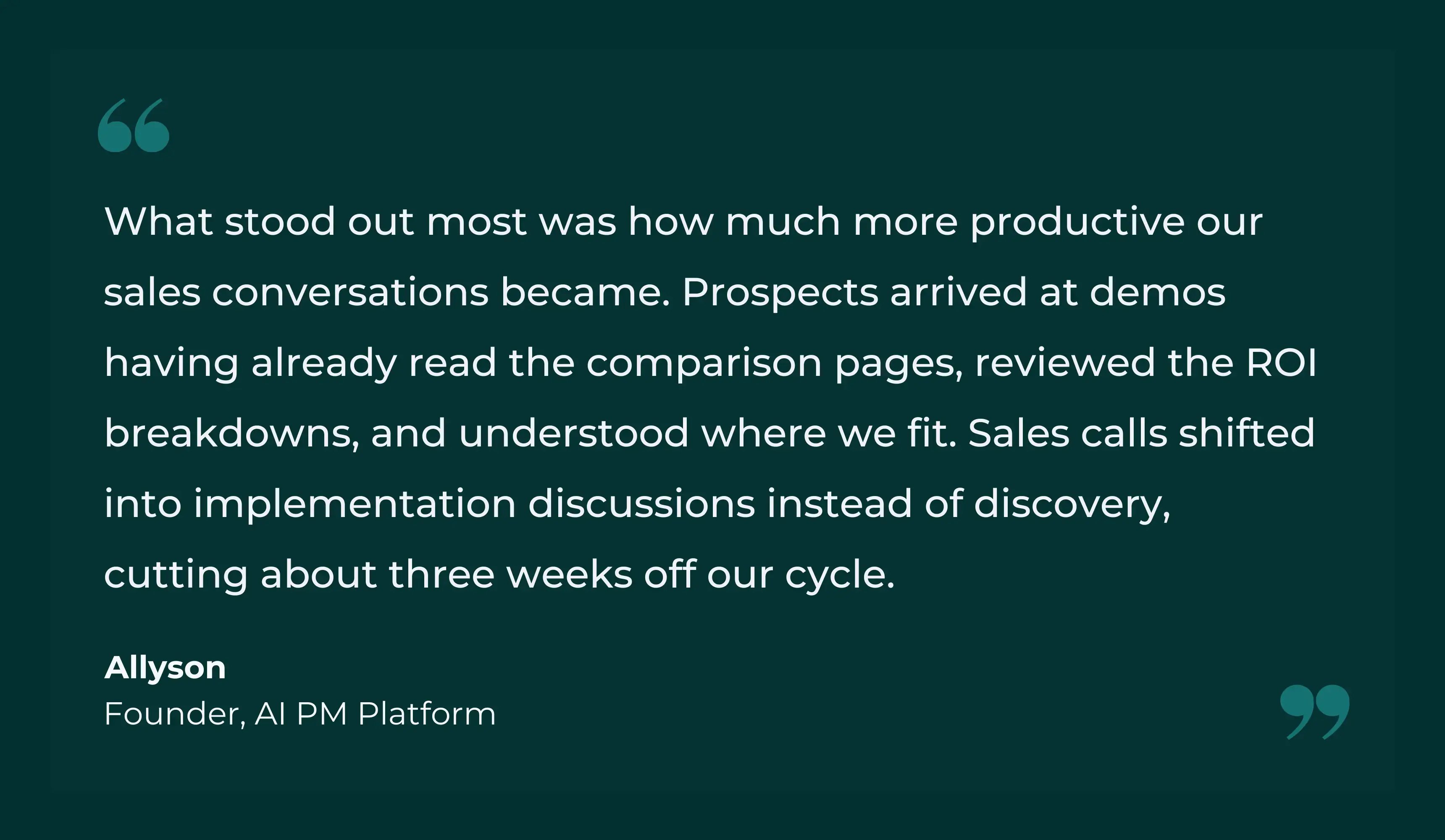
Sales cycles shortened by ~3 weeks
FAQs
Can’t I just hire one “full-stack” SEO lead and have them do everything?
Short answer: no.
A true “full-stack” SEO who is elite at technical architecture, content strategy, AND digital PR commands a $150K–$180K base. At that price point, you’re also competing with agencies, SaaS companies, and consultancies who can offer them more interesting work and better career progression.
Even if you land someone at $120K, you’ve created a single point of failure. When they leave (average tenure is 2 years), your entire organic channel stalls while you spend 3-4 months backfilling.
Better: Hire for one depth (e.g., strategic SEO lead who’s technical-first), then outsource content production and links. That’s a hybrid model in disguise.
What if we hire an SEO agency and it just... doesn’t work?
You can usually tell during the vetting process:
Red flags (generic agency):
- They pitch you before asking about your product, ICP, or sales cycle
- Proposal is a pre-built deck with your logo swapped in
- Promises “X rankings in Y months” without understanding your market
- Content samples are fluffy, keyword-stuffed, and could apply to any company
Green flags (specialised partner):
- Asks hard questions about your product, deal cycles, and sales objections
- Proposal is custom, references specifics from your site audit
- Talks about pipeline contribution, not just traffic
- Content samples are opinionated and demonstrate subject matter expertise
If we go hybrid, what’s the first role we should hire in-house?
Don’t hire an “SEO Manager” first. Hire a Head of Content or a Product Marketing Manager who’s obsessed with the buyer. Someone who can own the story, the ICP, and the strategy. They’ll be the “internal champion” who works with the agency and translates your product’s value into content.
What does the first year with an agency actually look like?
- Weeks 1–4: Immediate momentum. Good agencies move fast. You’ll have a complete site audit, keyword strategy, and content roadmap within the first three weeks. Technical improvements begin almost immediately.
- Months 2–4: Production scales. Content’s live. Rankings are moving. Your sales team reports noticeably higher-quality inbound.
- Months 5–7: Inflection point. Traffic doubles. High-intent pages reach page one. You’re closing your first wave of organic-sourced deals. The unit economics start proving out.
- Months 9–12: Channel maturity. Organic becomes a primary channel, contributing 20–30% of qualified pipeline. Your CAC improves as paid spend becomes more efficient.
In-House vs Agency vs Hybrid: Cost Calculator
This calculator lets you quantify the true Year 1 cost of in-house, agency, and hybrid models using your own market data.
How to use it:
- Enter what you’d pay for each role in your market (defaults are US averages)
- Adjust your tool stack costs if needed
- Select the agency tier that reflects your current stage
- Run the calculation and review total cost of ownership before your next budget or board discussion
Model Your SEO Total Cost of Ownership
Enter Your Local Salary Data