How We Drove a 178% Demo Increase
for an AI PM Platform

↑ 178%
Demo signups increased
↑ 62%
Trial-to-paid conversion
↓ 38%
Lower acquisition cost
Company
This B2B SaaS company offers an AI-powered project management platform built for product teams. It connects with tools like Jira and Slack to handle OKR planning, roadmap creation, and progress reporting; keeping execution on track and stakeholders aligned in real time.
Location 🇬🇧 United Kingdom
Industry Collaboration Software
Company size 11-50
"

What stood out most was the quality of our sales calls. Prospects arrived at demos having already read the comparison pages, run the ROI numbers, knew exactly where we fit. Sales calls shifted into implementation discussions instead of discovery, cutting about three weeks off our cycle.

Allyson
Founder, AI PM Platform

The Challenge

When Allyson reached out to us in March, their entire inbound funnel was cracking at the seams.

Traffic was there, very few converted. Trials started, but users churned before seeing value. The site explained what the product did, not why a VP of Engineering or CTO would choose it over their current tools. 

So we spent two weeks auditing every touchpoint, from homepage to demo to trial activation, mapping out the drop-off points costing them qualified pipeline.


HOMEPAGE CONVERSION RATE: 1.8%
Meaning: 98.2% of visitors left without requesting a demo or starting a trial.
Of the 1.8% who did convert to trial, only 12% converted to paid.
So for every 1,000 visitors:
  • 18 started trials
  • 2 became customers

Not great.


CONTENT CANNIBALISATION
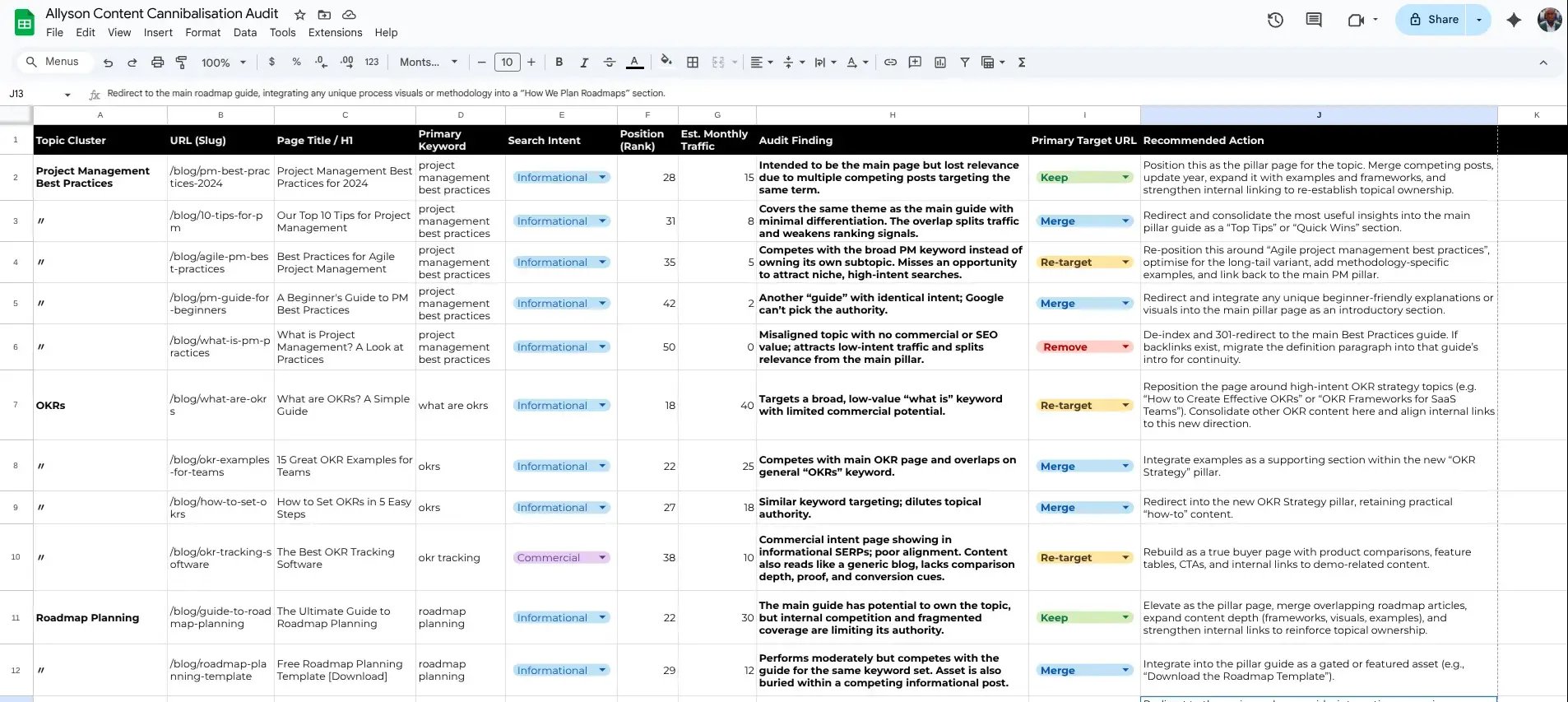
We pulled their SEMrush data and found 5 different articles on “PM best practices,” 4 on OKRs, and 4 on roadmap planning. All competing against each other in the SERPs. Google didn’t know which page to rank, so none of them performed well.

Content cannibalisation audit example showing overlapping pages
Content cannibalisation audit showing overlapping pages competing for the same keywords.
 
 
HOMEPAGE MESSAGING
The headline read: “AI-Powered Project Management Platform with Advanced Jira Integration.” Technically accurate, but no one wakes up thinking “I need advanced Jira integration today.”
They wake up thinking about the six hours they’ll waste this week creating status reports nobody reads. About tracking work scattered across Slack, email, and three different spreadsheets.
Average time on homepage before bouncing: 23 seconds. Not nearly enough time to understand the value, let alone book a demo.
 
 
ZERO BUYER-ENABLING CONTENT
No comparison pages. No implementation guides. No ROI calculators. Nothing that would help a VP of Product make a confident business case to their CFO.
Most articles covered entry‑level topics like:“What is project management?” 
Missing were topics on:
  • Change management: “How do we migrate 200 users from Asana without productivity loss?”
  • Financial justification: “What’s the measurable ROI against current tooling costs?”
  • Vendor comparison: “Where does this outperform Monday.com for enterprise teams?”
Every deal that stalled did so because buyers couldn’t answer these questions internally.

“I’ve been in growth roles for eight years, so I know when an agency’s just running through a template. This wasn’t that. Muiz looked at our full motion: organic performance, messaging clarity, trial experience, and showed how they were all undermining each other. That clarity alone gave us the most actionable growth roadmap we’ve had in years.”

— Allyson, Founder (three days after receiving the audit)
The Solution

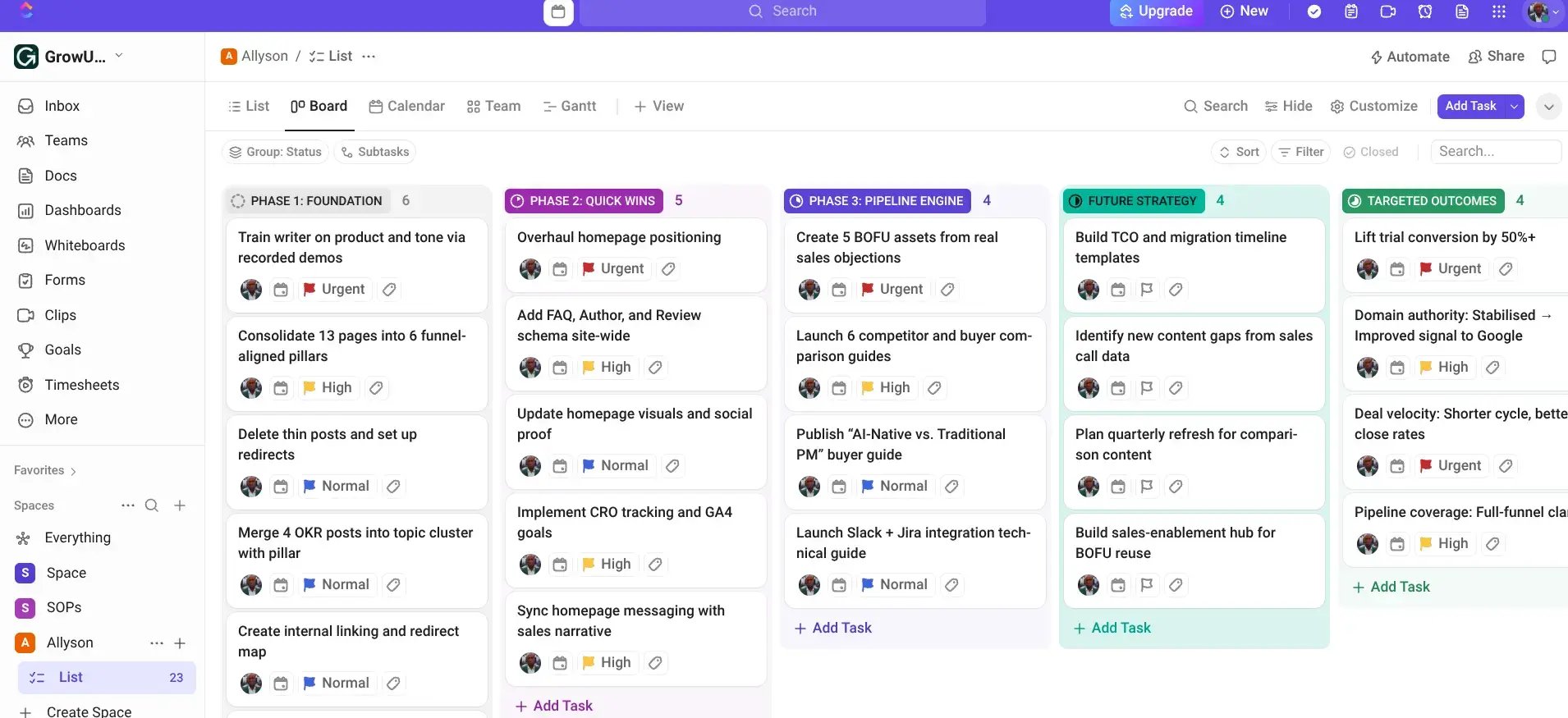
We had one quarter to rebuild their inbound engine around a single North Star: qualified demo bookings. The full strategy, mapped out:
Quarterly rebuild plan dashboard outlining priorities, owners, and timelines
A single view of how the funnel was rebuilt, step by step, across the quarter.
 
 
DAYS 1-14

Content Cleanup

The Problem: Nearly 13 pages competing for the same topics.
The Fix: Consolidated down to 6 strategic pieces aligned by funnel stage and intent.
Specific Content Consolidation Actions:
Merged “10 Project Mgt Best Practices” + “Essential PM Tips” + “Project Success Strategies” into  “Complete Guide to Product Team Management” (4,200 words, now ranking #3).
4 separate OKR posts merged into topic cluster with pillar page “OKR Implementation for Product Teams” 
4 roadmap articles consolidated into the “Product Roadmap Mastery” framework with downloadable templates.
Added FAQ, Author, and Review schema site-wide to improve SERP visibility, click-through rates, and trust signals for search and LLMs.
Result: Domain authority and rankings stabilised within three weeks, and sales started using the “OKR Implementation” guide to address objections in late-stage deals.
 
 
DAYS 15-18

Homepage Overhaul

This is where we saw our first measurable conversion increase. We replaced the tech-driven positioning with a clear narrative around tangible team efficiency and performance impact.
Homepage Messaging Before vs. After:
Old headline: “AI-Powered Project Management Platform with Advanced Jira Integration”
New headline: “Turn Your Jira Data Into Exec-Ready Progress Reports in Under 60 Seconds”
Old subhead: “Streamline workflows with intelligent automation and predictive analytics”
New subhead: “Product teams using our AI spend 80% less time on reporting and deliver 34% more features per quarter”
Within a week, conversion rate jumped from 1.8% to 4.2%.
Allyson dropped us a message on Slack: “I don’t know what you guys changed on the site, but we’ve got 18 demo requests since Monday. That’s more than we usually see in two weeks.”
 
 
DAYS 19-65

Strategic Bottom-Funnel Content Creation

With the foundation clean, we focused exclusively on content that answered questions buyers were already asking. Every brief was built from actual sales call recordings and objection patterns we pulled from their CRM notes.
High-intent Content Pieces Created:
“The Complete Guide to Implementing OKRs with Existing Jira Workflows” → ranked #2 within 30 days, driving 40+ monthly demos
“Step-by-Step: Creating Product Roadmaps That Actually Get Funded” → includes downloadable CFO presentation template
“Automating Sprint Planning: From 4 Hours to 15 Minutes”→ before/after case study with embedded time-savings calculator
“How to Set Up AI-Powered Progress Reporting (Without Overwhelming Your Team)” → directly addresses #1 objection from sales calls
“Advanced Slack + Jira Integration Guide for Product Teams”→ technical deep-dive with working code examples
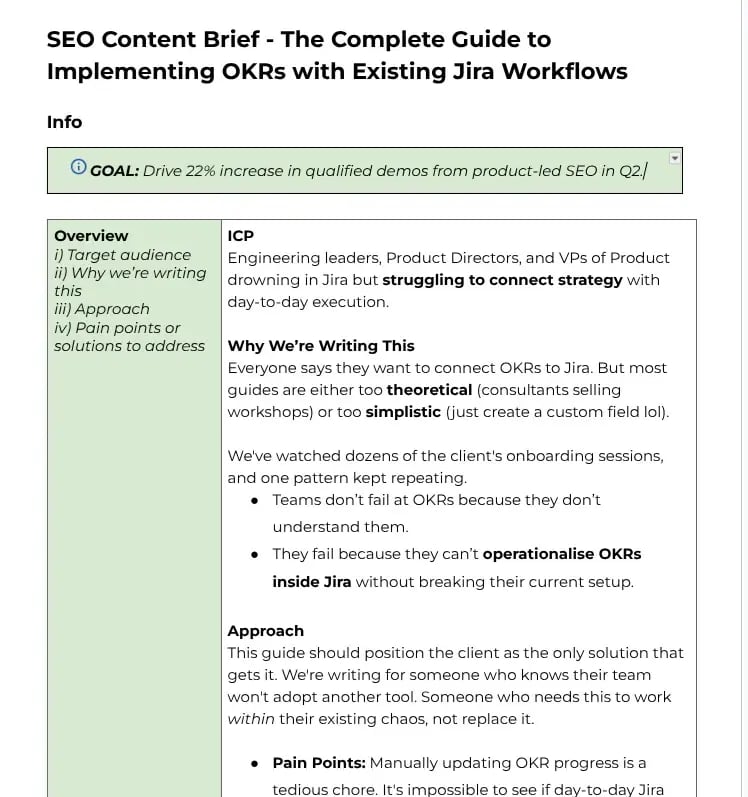
Process: Every brief outlined the structure, target ICP, product-led angles, and internal linking map before a single word was written.
SEO content brief dashboard aligning topics to OKRs and funnel stages
A sample content brief created during Allyson’s rollout.
We also brought in a contract writer and had themshadow the product team for a week, listening to demo recordings, reading support tickets. The content needed to feel like it came from someone who’d actually used the product, not a freelancer guessing.
 
 
DAYS 66-94

Comparison Content Strategy

The final phase focused on comparison and “alternative” content, assets prospects turn to when shortlisting options. We approached these as genuine buying guides; that meant being upfront about product fit and when to consider alternatives.
Key Assets Created:
“AI-Native vs. Traditional Project Management: Complete Buyer’s Guide” → most-visited page on the site, 67% demo booking rate
“When to Move Beyond Basic Jira: Signs You Need Intelligent Project Management” → built specifically for enterprise prospects
“Aha! vs. AI-Powered Roadmapping: ROI Comparison for Product Teams” → includes TCO calculator and migration timeline
“Monday.com Limitations: When Growing Teams Need More Intelligence” → addresses common switching triggers
“Linear vs. Next-Gen Product Management: Engineering Team Perspective" → technical comparison for dev-heavy orgs
The framework was straightforward: no competitor bashing, no capability inflation. By the time prospects booked a demo, they were already aligned on use case and fit, which made for faster cycles and higher close rates.

The Results

We’d set specific targets at the outset: double demo bookings, increase trial conversion by at least 40%, bring CAC down by at least a third. We hit every benchmark, and in some cases, exceeded them.

178%
Increase in monthly demo signups (from 23 to 64 per month)
62%
Improvement in trial-to-paid conversion (from 12% to 19%)
134%
Growth in qualified
organic traffic
38%
Reduction in customer
acquisition cost

The downstream effects were just as meaningful. Average sales cycle dropped from 87 days to 64 days because prospects were arriving further along in their evaluation. Demo-to-close rate also improved from 23% to 37%, largely because the content was doing a better job of filtering for fit before people even booked a call.

“What stood out most was how much more productive our sales conversations became. Prospects arrived at demos having already read the comparison pages, reviewed the ROI breakdowns, and understood where we fit. Sales calls shifted into implementation discussions instead of discovery. That shift alone cut our cycle time by about three weeks.”

— Allyson, Founder

The Takeaway

Marketing often stops at the lead, but we focused on the critical handshake between content and sales.
By shadowing their product team and analysing CRM objection patterns, we built a self-serve education engine. This ensured that when prospects finally reached Allyson’s sales team, they’d already validated fit and ROI internally. This total alignment across the funnel is what drove the numbers above.
Need similar results for your team?