---
title: Top 5 SaaS SEO Case Studies Worth Studying in 2026
description: 5 SaaS SEO case studies broken down by strategy and results, covering enterprise SEO, new markets, and programmatic SEO approaches.
image: https://www.seo-growup.com/hubfs/Top%205%20Saas%20SEO%20Case%20Studies.png
---
[Skip to main content](https://www.seo-growup.com/blog/top-saas-seo-case-studies-worth-studying#main)
[ ](https://www.seo-growup.com)
- [Show submenu for Services Services](https://www.seo-growup.com/b2b-saas-seo-services)
- [LLM SEO](https://www.seo-growup.com/llm-seo-agency-for-b2b-saas-companies)
- [Show submenu for SEO Audit SEO Audit](https://www.seo-growup.com/seo-audit-for-b2b-saas-companies)
- [LLM Visibility Audit](https://www.seo-growup.com/ai-search-audit-services)
- [Content Audit](https://www.seo-growup.com/b2b-saas-content-audit-services)
- [Copywriting Audit](https://www.seo-growup.com/website-copywriting-audit-service)
- [SEO Consultancy](https://www.seo-growup.com/seo-consultancy-for-b2b-saas-companies)
- [Fractional SEO](https://www.seo-growup.com/fractional-seo-consultancy-for-b2b-saas-companies)
- [Content Marketing](https://www.seo-growup.com/b2b-saas-content-marketing-agency)
- [Web Copywriting](https://www.seo-growup.com/b2b-saas-copywriting-agency)
- [SEO Link Building](https://www.seo-growup.com/b2b-saas-link-building-agency)
- [Pricing](https://www.seo-growup.com/pricing)
- Show submenu for Clients Clients
- Show submenu for By Stage By Stage
- [SEO for Startups](https://www.seo-growup.com/b2b-saas-startup-seo-agency)
- [SEO for Scale-Ups](https://www.seo-growup.com/seo-agency-for-b2b-saas-scaleups)
- [SEO for Enterprises](https://www.seo-growup.com/enterprise-b2b-saas-seo-agency)
- By Sector
- Show submenu for Company Company
- [Why GrowUp](https://www.seo-growup.com/why-growup)
- [Success Stories](https://www.seo-growup.com/success-stories)
- Show submenu for Resources Resources
- Show submenu for Hub Hub
- [Vetting SEO Partners](https://www.seo-growup.com/choosing-a-b2b-saas-seo-partner)
- [Audit Engagements](https://www.seo-growup.com/b2b-saas-seo-audit-guide)
- [Blog](https://www.seo-growup.com/growup-blog)
- [eBooks & Templates](https://www.seo-growup.com/ebooks-and-templates)
- [GTM Prompt Library](https://www.seo-growup.com/gtm-prompt-library)
- [Past Newsletters](https://www.seo-growup.com/newsletter)
- [Glossary](https://www.seo-growup.com/glossary)
Open main navigation
Close main navigation
- Show submenu for Services Services
- Services
- [Services](https://www.seo-growup.com/b2b-saas-seo-services)
- [LLM SEO](https://www.seo-growup.com/llm-seo-agency-for-b2b-saas-companies)
- Show submenu for SEO Audit SEO Audit
- SEO Audit
- [SEO Audit](https://www.seo-growup.com/seo-audit-for-b2b-saas-companies)
- [LLM Visibility Audit](https://www.seo-growup.com/ai-search-audit-services)
- [Content Audit](https://www.seo-growup.com/b2b-saas-content-audit-services)
- [Copywriting Audit](https://www.seo-growup.com/website-copywriting-audit-service)
- [SEO Consultancy](https://www.seo-growup.com/seo-consultancy-for-b2b-saas-companies)
- [Fractional SEO](https://www.seo-growup.com/fractional-seo-consultancy-for-b2b-saas-companies)
- [Content Marketing](https://www.seo-growup.com/b2b-saas-content-marketing-agency)
- [Web Copywriting](https://www.seo-growup.com/b2b-saas-copywriting-agency)
- [SEO Link Building](https://www.seo-growup.com/b2b-saas-link-building-agency)
- [Pricing](https://www.seo-growup.com/pricing)
- Show submenu for Clients Clients
- Clients
- Show submenu for By Stage By Stage
- By Stage
- [SEO for Startups](https://www.seo-growup.com/b2b-saas-startup-seo-agency)
- [SEO for Scale-Ups](https://www.seo-growup.com/seo-agency-for-b2b-saas-scaleups)
- [SEO for Enterprises](https://www.seo-growup.com/enterprise-b2b-saas-seo-agency)
- By Sector
- Show submenu for Company Company
- Company
- [Why GrowUp](https://www.seo-growup.com/why-growup)
- [Success Stories](https://www.seo-growup.com/success-stories)
- Show submenu for Resources Resources
- Resources
- Show submenu for Hub Hub
- Hub
- [Vetting SEO Partners](https://www.seo-growup.com/choosing-a-b2b-saas-seo-partner)
- [Audit Engagements](https://www.seo-growup.com/b2b-saas-seo-audit-guide)
- [Blog](https://www.seo-growup.com/growup-blog)
- [eBooks & Templates](https://www.seo-growup.com/ebooks-and-templates)
- [GTM Prompt Library](https://www.seo-growup.com/gtm-prompt-library)
- [Past Newsletters](https://www.seo-growup.com/newsletter)
- [Glossary](https://www.seo-growup.com/glossary)
- [Get In Touch](https://www.seo-growup.com/get-in-touch)
[Get In Touch](https://www.seo-growup.com/get-in-touch)
# Top 5 SaaS SEO Case Studies Worth Studying in 2026
by [Muiz Thomas](https://www.seo-growup.com/blog/author/muiz-thomas)
Sep 9, 2026
TL;DR:
These five SaaS SEO case studies demonstrate five distinct approaches to organic growth. **GrowUp** used bottom-of-funnel content and sales objections to influence $4.7M in pipeline; **Yapily** focused on technical buying content; **Plytix** used category education; **Dynamic Mockups** scaled programmatic SEO to 15,000+ pages; and **Typeform** turned product templates into an SEO channel generating $3M in annual LTV revenue.
## How We Selected the SaaS SEO Case Studies for This List
There are plenty of SaaS SEO case studies out there, but they don’t all cover the same type of SEO challenge. We wanted this list to be useful across different stages of growth, so we grouped the examples into three areas:
- **Enterprise SaaS:** Companies dealing with large sites, multiple audiences, and longer, more complex buying journeys.
- **New or competitive markets:** Companies building organic visibility in categories where competition is high or the market itself is still developing.
- **Programmatic SEO and Product-Led SEO:** Companies that built their SEO strategy around the product itself, using templates, use cases, or other product features as the raw material for pages.
Within each group, we looked for case studies that explained what was actually done and showed measurable results connected to pipeline or revenue, rather than simply reporting a traffic increase.
## Quick Comparison: The 5 SaaS SEO Case Studies at a Glance
| Case Study | Core Strategic Lever |
| --- | --- |
| **How GrowUp Built $4.7M in Content-Influenced Pipeline for a B2B SaaS AI Platform** | **Sales-Led BOFU & Objection Handling:** Created content around the deal-blockers coming up in sales conversations, including CTO concerns and CFO budget justification, then used multi-touch attribution to measure its influence on enterprise opportunities. |
| **How Yapily Increased Organic Inbound Leads by 2.8x** | **Deep Technical Relevance:** Abandoned generic explainer traffic to build highly technical, product-integrated buying assets based on direct customer research. |
| **How Plytix Increased Monthly Inbound Leads by 5x** | **Category Education & Displacement:** Captured early-stage frustration by explicitly comparing their emerging category (PIM) against the legacy solutions users were outgrowing (spreadsheets, DAMs). |
| **How Dynamic Mockups Increased Monthly Signups by 3,035%** | **High-Velocity Programmatic SEO:** Built a keyword matrix from product variables to dynamically generate 15,000+ highly specific, long-tail template pages in under 90 days. |
| **How Typeform Generated $3M in Annual LTV Revenue From SEO** | **Product-Led SEO & Viral Loops:** Turned the product's vast library of templates into indexable BOFU landing pages, fueled by a self-perpetuating user backlink engine. |
## SEO Case Studies from Enterprise B2B SaaS Companies
Enterprise SEO comes with a different set of challenges. Sales cycles are longer. Buying decisions happen by committee: a technical evaluator, a finance approver, and at least one person whose job is to find reasons not to buy.
That makes the content strategy more complicated, too. The person who finds a page in Google may not be the person who signs off on the purchase, so the site needs to answer different questions at different points in the journey.
### 1. How GrowUp Built $4.7M in Content-Influenced Pipeline for a B2B SaaS AI Platform
[**⮞ Read the original case study here.**](https://www.seo-growup.com/blog/ai-pm-platform-case-study) .
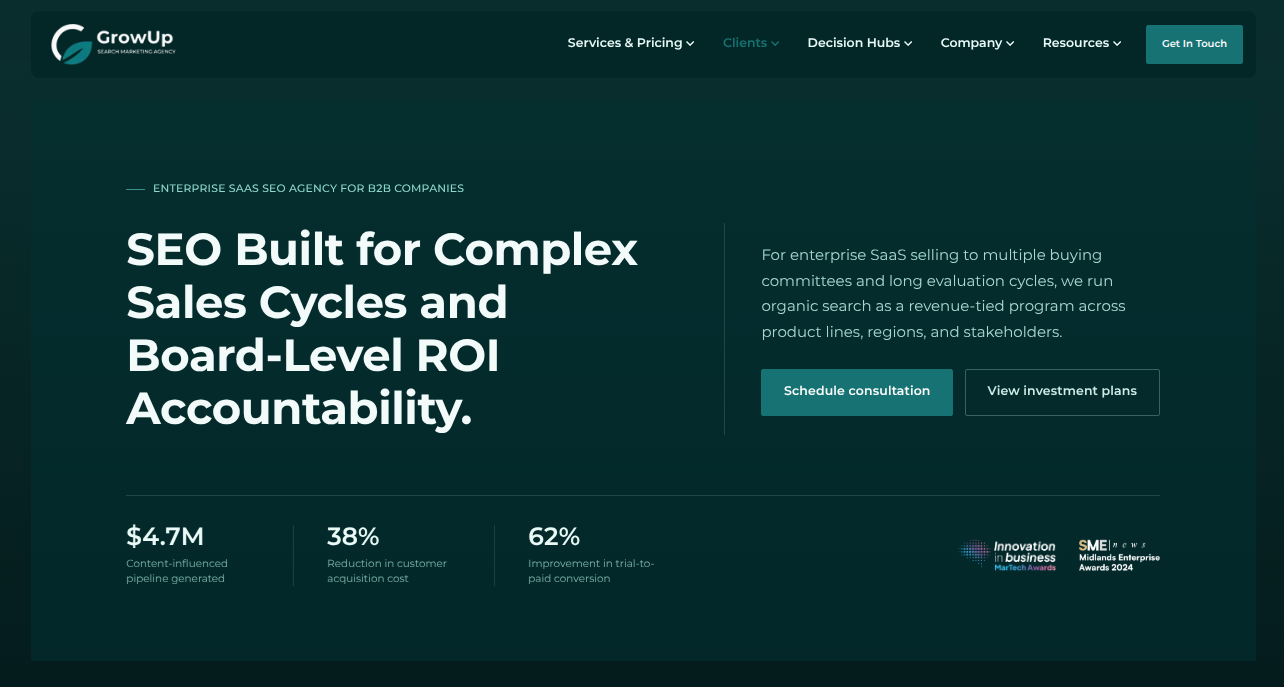
I’ll try to keep the self-promotion to a minimum, but I’m including this one because it’s the clearest example I have of a problem that shows up constantly in enterprise SaaS and almost nobody talks about: **traffic and revenue can grow completely independently of each other**, and if you’re only watching the traffic chart, you won’t notice you have a problem until someone in finance asks why marketing spend keeps climbing while the pipeline doesn’t.
**Context:**
This AI project management platform came to us after more than a year of consistent organic growth. Traffic was increasing and free trials were coming in every month, but the numbers further down the funnel weren’t keeping up. The homepage converted at 1.8%, and only 12% of trials became paying customers.
**Execution:**
We spent the first two weeks [reviewing the content library](https://www.seo-growup.com/b2b-saas-content-audit-services), conversion data, sales process, and attribution. We found the site had plenty of content for people researching project management, but very little that helped an enterprise buyer evaluate the product, justify the investment, or get other stakeholders on board.
**That meant keyword research alone wasn’t going to tell us what to create. We needed to understand what was actually coming up in sales conversations.**
So we reviewed CRM notes and demo recordings with the sales team; we also spoke with the product team and looked at support conversations. That gave us a clear list of the questions and objections coming from Finance, Procurement, CTOs, and internal champions.
A few of the pieces we created based on those objections::
→
**“It takes too much time”:**→ We created “Automating Sprint Planning: From 4 Hours to 15 Minutes,” using a before-and-after case study and an interactive time-savings calculator to make the efficiency case concrete.
→
**“How do we justify the budget?”:** → We created “Step-by-Step: Creating Product Roadmaps That Actually Get Funded,” with a downloadable CFO presentation template to help the champion make the case to Finance.
→
**“Will this work with our engineering team?”** → We created “How to Set Up AI-Powered Progress Reporting Without Overwhelming Your Engineering Team,” addressing the technical and implementation concerns that came up in CTO conversations.
**Results:**
Nine months in:
- Monthly demo signups grew from 23 to 64
- Trial-to-paid conversion jumped from 12% to 19%
- $4.7M in content-influenced pipeline across 189 qualified enterprise deals
We also connected the program to [AttributeIQ,](https://attribute-iq.com/?utm_source=growup&utm_medium=referral)our multi-touch attribution platform, specifically so this client could see which content was influencing pipeline and closed-won revenue, rather than just tracking traffic and conversions.
**📚 Read more:** Check out the full [AI PM Case Study](https://www.seo-growup.com/blog/ai-pm-platform-case-study)
### 2. How Yapily Increased Organic Inbound Leads by 2.8x

[**⮞ Read the original case study here.**](https://www.mintcopywritingstudios.com/blog/yapily-case-study).
**Context:**
Yapily is one of the best known open banking API providers in the UK, trusted by companies like Google, Adyen, QuickBooks, and Pleo. Before working with Mint Studios, their content sat at too high a level for a technical, competitive space like open banking, so it wasn't taken seriously internally and wasn’t resonating with the audience it needed to reach.
**Execution:**
Mint Studios started with a two-week diagnostic to understand the opportunity and put a financial value on it. From there, the focus was on finding keywords that could bring in buyers rather than generic explainer traffic, while rebuilding attribution after GA4 stopped giving a clear picture of which content was driving leads.
That led to a stronger focus on content for people closer to a buying decision, based on sales and customer research. Topics included:
- **Pay by Bank API**
- **API for bank transactions**
- **Instant bank account verification**
- **Open banking for lenders**
Alongside new content, the team went back through Yapily’s existing articles, sharpened the hooks, added more technical depth pulled from interviews with Yapily’s own experts, and worked in product information that buyers needed to evaluate the product.
**Results:**
Over roughly 1.5 years:
- 2.8x increase in organic inbound website leads
- 43% of first/last-touch leads from the blog were qualified as engaged
- Ranking on page one for 94% of target buying keywords, with 62.5% of tracked keywords in the top 3
**📚 Read more:** Check out the full [Yapily Case Study](https://www.mintcopywritingstudios.com/blog/yapily-case-study)
## SEO Case Studies from New or Competitive SaaS Markets
Competing in an established B2B SaaS category is tough. The biggest companies already have years of content and brand recognition behind them. For newer companies, the opportunity is usually finding areas where those advantages matter less and building enough useful content to compete.
### 3. How Plytix Increased Monthly Inbound Leads by 5x
[**⮞ Read the original case study here.**](https://www.yesoptimist.com/case-study-plytix/).
**Context:**
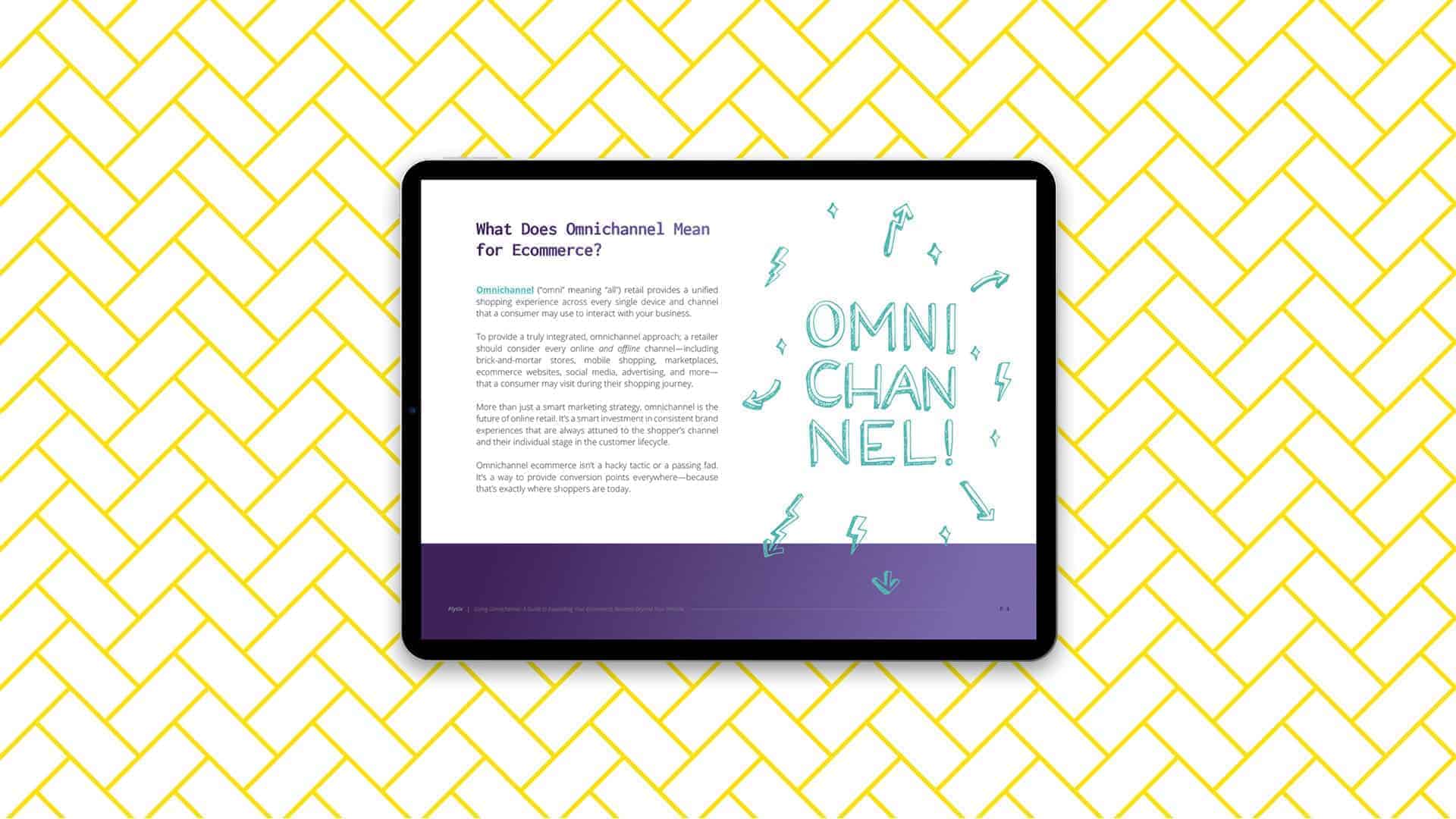
Plytix is a Product Information Management (PIM) platform for ecommerce and retail teams. When Optimist started working with the company, PIM was still a relatively new category.
Many potential customers were still using spreadsheets, DAMs, or other tools to manage product information, so there was a lot of education needed around where PIM fit and why a growing ecommerce operation might need it.
**Execution:**
Optimist built the strategy around those early education gaps. They created content that helped buyers understand what PIM actually was, how it differed from the DAMs and spreadsheets they were already using, and what started to break as their product catalogs grew across more stores and sales channels.
That included content around:
- **PIM vs. related tools**: explaining the differences between PIM, DAMs, spreadsheets, and other systems
- **Growing ecommerce operations**: covering the problems that came with managing product information across multiple channels
- **Product data management**: addressing issues such as inconsistent information, channel requirements, and growing product catalogs
- **Guides, ebooks, and infographics**: giving potential customers practical resources as they evaluated how they were managing product information
**Results:**
Over roughly two years:
- 5x increase in monthly inbound leads
- 266% increase in total website traffic
- Content marketing and SEO became Plytix’s #1 growth channel
- Significant increase in inbound demand generated through content
**📚 Read more:** Check out the full [Plytix Case Study](https://www.yesoptimist.com/case-study-plytix/)
## Product-Led and Programmatic SaaS SEO Case Studies
Some SaaS products have hundreds or thousands of potential pages built into the product itself. Think templates, use cases, integrations, or other variations people might search for.
Instead of creating all those pages manually, **programmatic SEO** gives you a way to build them from the same underlying template, changing the content for each search or use case.
### 4. How Dynamic Mockups Increased Monthly Signups by 3,035%

[**⮞ Read the original case study here.**](https://www.omnius.so/blog/programmatic-seo-case-study).
**Context:**
Dynamic Mockups is an AI image generator that helps creators and marketers produce visuals for different platforms without any design skills. The product was solid and had decent traction, but almost no organic visibility to go with it. Before working with Omnius, the site ranked for just 13 keywords, none of them in the top 10, and brought in only 67 signups a month.
**Execution:**
Omnius identified programmatic SEO as the channel with the most room to grow, and built the strategy around it in a few stages:
- **Keyword research and intent mapping**: auditing Dynamic Mockups' existing library of use cases and templates, then building a keyword matrix around variables like object type, format, orientation, and use case.
- **Template design and automation**: a single modular landing page template that auto-populated titles, headers, alt text, and CTAs based on each keyword variation, so every page felt built for its specific query
Using this system, Omnius launched more than 15,000 pages in less than 90 days. Each page targeted a specific long-tail search and used the same structure, with the content and images changing based on the search term.
**Results:**
Over 10 months:
- Monthly signups grew from 67 to over 2,100, a 3,035% increase
- Organic traffic grew 850%, from 102 to 8,500+ monthly clicks
- Visitor-to-signup conversion rate climbed from 10.4% to 24.81%
- Keyword rankings grew from 13 to over 5,742, including 305+ page-one rankings and 42+ in the top 3
**📚 Read more:** Check out the full [Dynamic Mockups Case Study](https://www.omnius.so/blog/programmatic-seo-case-study)
### 5. How Typeform Generated $3M in Annual LTV Revenue From SEO

[**⮞ Read the original case study here.**](https://www.spicymargarita.co/archive/typeform-seo-case-study).
**Context:**
Typeform pioneered the one-question-at-a-time survey format and had strong product-market fit, but no organic strategy to speak of. When Jake Stainer joined as employee #29 in 2015, the company had just crossed $1M in annual revenue and hadn’t yet built out SEO as a channel.
**Execution:**
Jake built the growth strategy around a product-led SEO model, executed in a few stages:
- **Template-driven landing pages**: Typeform’s product supported thousands of use cases, so each template got its own CRO-optimised landing page targeting a specific bottom-of-funnel keyword, letting visitors use the product directly from the page.
- **Revenue-focused prioritisation**: Keywords were scored on traffic potential, backlink difficulty, estimated conversion rate, and retention data from customer success, so the roadmap of 5-6 pages a month was built around LTV, not just search volume.
- **Backlink growth loop**: A “powered by Typeform” link embedded in every published form, later evolved into use-case-specific anchor text pointing to the matching landing page, scaling the domain to 2.3M backlinks.
- **Internal linking sprints**: Weekly team sessions dedicated to adding contextual internal links from blog content to priority pages, which is what actually moved rankings (navigation links alone had no impact).
**Results:**
Over 3.5 years:
- SEO grew into a $3M a year channel in lifetime value revenue
- 30,000+ non-branded organic signups (excluding feature, pricing, and product pages)
- 50,000 paying customers acquired through organic search
- Domain rating reached 93, with 2.3M+ backlinks and a spot in the top 200 sites of all time by DR
**📚 Read more:** Check out the full [Typeform Case Study](https://www.spicymargarita.co/archive/typeform-seo-case-study)
## Applying These Case Study Lessons to Your SaaS
If you’ve read this far, you’re probably thinking about which of these approaches fits your company. Here’s a way to narrow it down:
Ask yourself three questions:
1. **Who is actually making the purchase decision?** If it’s a committee, your content needs to answer the different questions each person brings to the buying process: *Does this solve our problem? Will it work with our stack? What will it cost? Can I justify this internally?*
2. **How well does your market understand the problem you solve?** If the category is early or crowded, you’ll need to invest in education before you can invest in conversion.
3. **Does your product create anything repeatable?** Templates, integrations, calculators, or use-case configurations can all become SEO assets with the right system.
*If you’re trying to figure out where your own SEO strategy should focus, we do detailed audits like the one described in the [GrowUp case study above](https://www.seo-growup.com/blog/top-saas-seo-case-studies-worth-studying#growup-case-study), happy to take a look at your funnel and tell you honestly whether SEO is the right lever right now.*
**\[[Talk to us about your SEO strategy](https://www.seo-growup.com/get-in-touch)\]**
## FAQs
What can SaaS SEO case studies teach you about building an organic growth strategy?
The strongest SaaS SEO case studies show that organic growth rarely comes from publishing more content alone. The strategy depends on the company’s market, buyers, product, and commercial goals. Enterprise SaaS may need decision-stage content, while a product with thousands of use cases may have a stronger programmatic opportunity. The common thread is matching SEO to how the business actually grows.
What makes a SaaS SEO case study credible and useful?
A credible SaaS SEO case study explains what changed, why those changes were made, and what happened afterwards. Traffic growth alone is not enough. The most useful examples show specific actions, timeframes, conversion or pipeline results, and enough context to understand the starting point. Without that detail, it is difficult to separate a repeatable strategy from a favourable result.
What kind of results can SaaS companies realistically expect from SEO?
There is no single benchmark because SaaS SEO results depend heavily on the market, starting point, product, and execution. The case studies in this list range from higher organic leads and signups to measurable pipeline and revenue. The important point is to set targets around qualified demand and commercial outcomes, rather than assuming more organic traffic automatically means more customers.
How long does it usually take for a SaaS company to see SEO results?
The case studies here show that meaningful SaaS SEO results generally take months rather than weeks. The timeframe varies with domain authority, competition, technical issues, content quality, and the size of the opportunity. Some programmes can produce early ranking or conversion improvements within a few months, while significant organic lead and revenue growth usually requires sustained execution.
What’s a realistic SEO budget based on the results shown in these case studies?
Budgets in these case studies ranged from a few thousand pounds a month for diagnostics and content, up to significant investment for programmatic builds spanning thousands of pages. There’s no fixed number: the right budget depends on your category, content gaps, and whether you’re consolidating existing content or building from scratch.
Are SaaS SEO case studies from other industries still relevant to my company?
They can be, but the strategy matters more than the headline result. A programmatic SEO approach from another SaaS company may be relevant if your product also has scalable use cases, while an enterprise case study may offer useful lessons if your sales process involves multiple stakeholders. The closer the underlying business model and search behaviour, the more transferable the example.
Are these SaaS SEO case studies still applicable with how much SEO has changed?
Yes, although the tactics need to be evaluated against the current search environment. Search behaviour, AI-generated answers, SERP features, and Google’s systems have changed, but the fundamentals shown across these SaaS SEO case studies remain relevant: understand search intent, create genuinely useful pages, build around the product and buyer, and measure whether organic visibility contributes to business results.

Author
Muiz Thomas [in](https://www.linkedin.com/in/muiz-thomas-seo/)
Founder & CMO, GrowUp
Muiz is the founder of GrowUp, a B2B SaaS search marketing agency. His work has driven over £5M in qualified pipeline across construction tech, AI platforms and enterprise software. Outside of work, he’s probably rewatching a match he’s already seen the highlights of, or arguing about something that doesn’t matter nearly as much as he’s making it sound.
The Marketing Brief
by GrowUp
Get monthly GTM strategies, campaign breakdowns, and category trends we’re seeing across high-growth B2B SaaS teams.
Which best describes you? Founder / CEO CMO / VP Marketing Head of Growth / Demand Gen Fractional CMO / Consultant Investor / Board Member
SUBSCRIBE TO THE BRIEF →
### Is your SEO investment actually connected to pipeline growth?
Find out exactly which parts of your funnel SEO is supporting, and which gaps are stalling demos and trials.
[REQUEST YOUR AUDIT →](https://www.seo-growup.com/seo-audit-for-b2b-saas-companies)
Share This Post

We help B2B SaaS teams turn search into a proven revenue channel through GTM-aligned SEO and content.
Get in Touch
The Marketing Brief
by GrowUp
Monthly GTM insights we use to drive SQLs and scale MRR for high-growth B2B SaaS companies.
Email\*
Which best describes you Founder / CEO CMO / VP Marketing Head of Growth / Demand Gen Fractional CMO / Consultant Investor / Board Member
SUBSCRIBE TO THE BRIEF →
### Services
- [B2B SaaS SEO Consulting](https://www.seo-growup.com/seo-consultancy-for-b2b-saas-companies)
- [B2B SaaS Content Marketing](https://www.seo-growup.com/b2b-saas-content-marketing-agency)
- [B2B SaaS SEO Audit](https://www.seo-growup.com/seo-audit-for-b2b-saas-companies)
- [GTM Advisory](https://www.seo-growup.com/go-to-market-advisory-for-b2b-saas)
- [SEO for Startups](https://www.seo-growup.com/b2b-saas-startup-seo-agency)
- [SEO for Scale-Ups](https://www.seo-growup.com/seo-agency-for-b2b-saas-scaleups)
- [SEO for Enterprises](https://www.seo-growup.com/enterprise-b2b-saas-seo-agency)
### Legal
- [Privacy Policy](https://www.seo-growup.com/privacy-policy)
- [Terms & Conditions](https://www.seo-growup.com/terms-and-conditions)
### Resources
- [SEO Partner Hub](https://www.seo-growup.com/choosing-a-b2b-saas-seo-partner)
- [Blog](https://www.seo-growup.com/growup-blog)
- [eBooks & Templates](https://www.seo-growup.com/ebooks-and-templates)
- [GTM Prompt Library](https://www.seo-growup.com/gtm-prompt-library)
- [Past Newsletters](https://www.seo-growup.com/newsletter)
### Company
- [Why GrowUp](https://www.seo-growup.com/why-growup)
- [Success Stories](https://www.seo-growup.com/success-stories)
- [Pricing](https://www.seo-growup.com/b2b-saas-marketing-services-and-pricing)
- [Contact Us](https://www.seo-growup.com/get-in-touch)
×

## Is Your SaaS Invisible in ChatGPT, Perplexity and Other LLMs?
Get a comprehensive AEO & AI Search Audit to see where you rank across LLMs and how to capture AI search traffic.
[VIEW SAMPLE REPORT](https://www.seo-growup.com/blog/ai-search-visibility-audit-sample) [REQUEST AN AUDIT](https://www.seo-growup.com/get-in-touch)
★★★★★
“Hands down the most actionable insights we’ve received.”

Savas Vedova
Founder, Stormkit
[](https://www.seo-growup.com)
Services
Core Services
[**LLM SEO** Get cited in ChatGPT, Perplexity and Google AI answers. →](https://www.seo-growup.com/llm-seo-agency-for-b2b-saas-companies) [**Web Design** High-converting websites for complex B2B products. →](https://www.seo-growup.com/b2b-saas-web-design-agency) [**$4.7M** Content-influenced pipeline generated *Read case study →*](https://www.seo-growup.com/blog/ai-pm-platform-case-study)
More Services
[SEO Audit](https://www.seo-growup.com/seo-audit-for-b2b-saas-companies) [SEO Consultancy](https://www.seo-growup.com/seo-consultancy-for-b2b-saas-companies) [Fractional SEO](https://www.seo-growup.com/fractional-seo-consultancy-for-b2b-saas-companies) [Content Marketing](https://www.seo-growup.com/b2b-saas-content-marketing-agency) [Web Copywriting](https://www.seo-growup.com/b2b-saas-copywriting-agency) [SEO Link Building](https://www.seo-growup.com/b2b-saas-link-building-agency) [All services →](https://www.seo-growup.com/b2b-saas-seo-services)
By Stage
[Startups](https://www.seo-growup.com/b2b-saas-startup-seo-agency) [Scale-Ups](https://www.seo-growup.com/seo-agency-for-b2b-saas-scaleups) [Enterprises](https://www.seo-growup.com/enterprise-b2b-saas-seo-agency)
By Sector
[FinTech](https://www.seo-growup.com/fintech-content-marketing-agency) [HR Tech](https://www.seo-growup.com/hrtech-content-marketing-agency) [EdTech](https://www.seo-growup.com/edtech-content-marketing-agency)
Strategy / Content / Tech / Growth
### More visibility. More pipeline.
We combine strategy, UX, design and development to create websites that support demand generation, sales and brand growth.
[Explore our approach](https://www.seo-growup.com/why-growup)
Our Work
Portfolio
[Writing Portfolio](https://www.seo-growup.com/content-writing-portfolio-for-b2b-saas) [Design Portfolio](https://www.seo-growup.com/web-design-portfolio)
[Success Stories](https://www.seo-growup.com/success-stories)
[Pricing](https://www.seo-growup.com/pricing)
[Why GrowUp?](https://www.seo-growup.com/why-growup)
Resources
[Blog](https://www.seo-growup.com/growup-blog)
Hub
[Vetting SEO Partners](https://www.seo-growup.com/choosing-a-b2b-saas-seo-partner) [Audit Engagements](https://www.seo-growup.com/b2b-saas-seo-audit-guide)
[eBooks & Templates](https://www.seo-growup.com/ebooks-and-templates) [GTM Prompt Library](https://www.seo-growup.com/gtm-prompt-library) [Past Newsletters](https://www.seo-growup.com/newsletter) [Glossary](https://www.seo-growup.com/glossary)
[Get In Touch](https://www.seo-growup.com/get-in-touch)
```json
{
"@context" : "https://schema.org",
"@type" : "BlogPosting",
"author" : {
"@type" : "Person",
"name" : "Muiz Thomas",
"url" : "https://www.seo-growup.com/blog/author/muiz-thomas"
},
"dateModified" : "2026-09-09T20:07:06.009Z",
"datePublished" : "2026-09-09T20:07:06.000Z",
"headline" : "Top 5 SaaS SEO Case Studies Worth Studying in 2026",
"image" : [ "https://www.seo-growup.com/hubfs/Top%205%20Saas%20SEO%20Case%20Studies.png" ],
"mainEntityOfPage" : {
"@id" : "https://www.seo-growup.com/blog/top-saas-seo-case-studies-worth-studying",
"@type" : "WebPage"
},
"publisher" : {
"@type" : "Organization",
"logo" : {
"@type" : "ImageObject"
},
"name" : "GrowUp"
}
}
```
```json
{
"@context" : "https://schema.org",
"@type" : "ProfessionalService",
"address" : {
"@type" : "PostalAddress",
"addressCountry" : "GB"
},
"alternateName" : "GrowUp SEO",
"areaServed" : {
"@type" : "Place",
"name" : "United Kingdom"
},
"audience" : {
"@type" : "Audience",
"audienceType" : [ "B2B SaaS Founders", "CMOs", "VPs of Marketing", "In-House Marketing Teams" ]
},
"award" : [ "Most Creative SEO Agency - Martech Awards", "SME News Midlands Enterprise Awards" ],
"description" : "Search marketing agency for B2B SaaS companies. We help teams turn organic and AI search into a fully accountable revenue channel with clear attribution to demos, pipeline, and measurable MRR.",
"email" : "mailto:hello@seo-growup.com",
"founder" : {
"@type" : "Person",
"name" : "Muiz Thomas"
},
"hasOfferCatalog" : {
"@type" : "OfferCatalog",
"itemListElement" : [ ],
"name" : "B2B SaaS Growth Services"
},
"knowsAbout" : [ "B2B SaaS SEO", "Search Engine Optimisation", "Content Marketing", "Go-to-Market Strategy", "SaaS Marketing", "Pipeline Generation", "Revenue Attribution", "AI Search Optimisation" ],
"name" : "GrowUp",
"priceRange" : "£3500+",
"sameAs" : [ "https://www.linkedin.com/company/b2b-saas-seo-agency/", "https://www.instagram.com/seo.growup/" ],
"serviceType" : [ "SEO Consulting", "Content Marketing", "GTM Advisory", "SEO Audit" ],
"slogan" : "Organic & AI Search Programs Built to Deliver SQLs, Pipeline and Measurable MRR",
"url" : "https://www.seo-growup.com/"
}
```